Key Takeaway
- A plug-in space heater delivers 100,000 BTU of heat for $5.38 at the national average electric rate. A 95 percent gas furnace delivers the same heat for $1.42. The heater costs 1.8 to 6.6 times more in every state, worst in Michigan and Illinois, closest in Florida.
- The "heat one room, turn down the furnace" strategy fails on DOE's own setback math: in Ohio, an eight-hour heater session costs $2.30, and a 10-degree setback would need a $714 monthly gas bill to save that much.
- The heater only wins when the rest of the house gets genuinely cold, around 55 degrees, and the heated room is a small fraction of the house's heat loss. A closed bedroom in a big house, not an office for eight hours.
- Oil and propane homes are a closer call (ratios of roughly 1.8 to 2.4), and a window or ductless heat pump beats both fuels outright, delivering a therm for $2.25 in Ohio versus $3.08 for propane.
- Keep the furnace on and use the thermostat setback. Save the plug-in heater for the bathroom for twenty minutes. If you heat with oil or propane, price a heat pump before you price a heater.
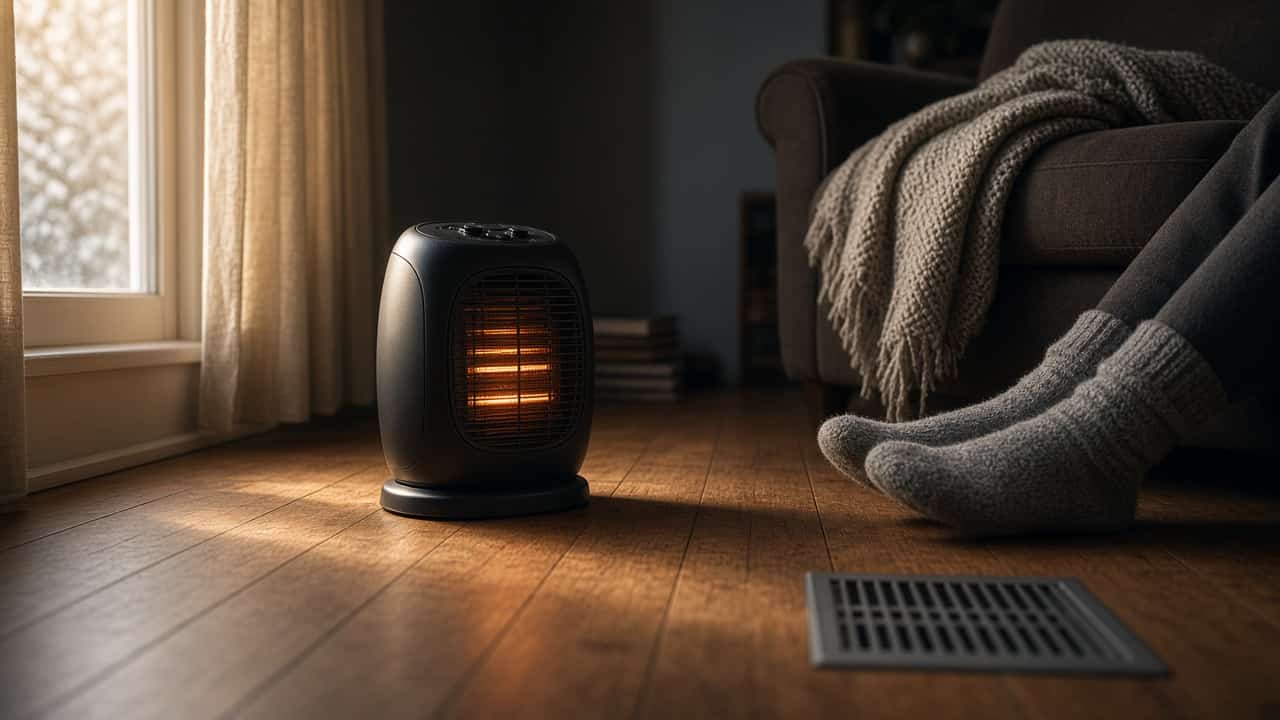
Per unit of heat, a 1,500-watt heater costs 1.8 to 6.6 times what a gas furnace costs, using EIA's own January gas and June electricity prices. It pays off only when the rest of the house goes cold.
Every October the same folk wisdom comes out of the closet with the sweaters: heat the room you're in, not the whole house, and the little heater pays for itself. The physics has never agreed. Electricity costs 18.34 cents a kilowatt-hour on average as of June, up 5 percent in a year and a third in five, while the gas that feeds most American furnaces went into this winter with storage 5 percent above its five-year average. Run the space heater vs central heat question through the Energy Information Administration's own price tables, state by state, and the answer stops being a matter of opinion: a plug-in heater delivers heat at 1.8 to 6.6 times the cost of a gas furnace in every state in the country. The only way it saves money is if it lets you turn most of your house into a walk-in refrigerator.
Per unit of heat, electricity loses to gas everywhere
Start with the unit that makes the two comparable. A therm is 100,000 BTU, roughly what a furnace throws off in an hour of hard running. A plug-in heater needs 29.3 kilowatt-hours to make a therm of heat, and it does so with no losses at the outlet, which is where the "100 percent efficient" marketing line comes from. At the national average rate, that therm costs $5.38.
A gas furnace buys the same heat at January's residential price of $13.96 per thousand cubic feet, which is $1.35 per therm of gas. A modern 95 percent furnace delivers it for $1.42. An older 80 percent unit delivers it for $1.68. So the national ratio is 3.2 to 3.8: the plug-in heater costs three to four dollars for every dollar the furnace spends on the same warmth.
| State | Plug-in heater, per 100,000 BTU | 95% gas furnace | Heater costs |
|---|---|---|---|
| Michigan | $6.74 | $1.02 | 6.6x |
| Illinois | $5.83 | $0.98 | 6.0x |
| New York | $8.64 | $1.63 | 5.3x |
| Ohio | $5.62 | $1.12 | 5.0x |
| Pennsylvania | $6.37 | $1.44 | 4.4x |
| California | $10.18 | $2.33 | 4.4x |
| U.S. average | $5.38 | $1.42 | 3.8x |
| Massachusetts | $8.68 | $2.62 | 3.3x |
| Georgia | $4.80 | $1.59 | 3.0x |
| Texas | $4.67 | $1.67 | 2.8x |
| Washington | $4.37 | $1.76 | 2.5x |
| Florida | $4.43 | $2.40 | 1.8x |
Electricity from EIA's June 2026 residential averages; gas from EIA's January 2026 residential prices, all taxes and delivery included (Florida uses December because January was not reported). The pattern is not what most people expect. The Northeast, with its famously expensive power, is not where the heater loses worst. The Midwest is, because Michigan and Illinois pay above-average electric rates on top of some of the cheapest delivered gas east of the Rockies. Florida is the closest call in the nation, and even there the heater costs almost double.
The DOE setback rule is why the heater rarely pays
The case for the heater rests on the thermostat. Heat one room electrically, turn the furnace down for the rest, and the furnace savings are supposed to cover the electricity. The Department of Energy publishes the number for that: setting the thermostat back 7 to 10 degrees for eight hours a day saves as much as 10 percent of your heating bill, roughly 1 percent per degree.
Put that against an Ohio bill. A 1,500-watt heater running eight hours costs $2.30 a day at 19.19 cents. A 10-degree setback saves 10 percent of that day's gas. For the two to break even, the day's gas would have to cost $23, which is a $714 gas bill for January. At a heroic 15-degree setback, the break-even bill is still $476 a month. Most Ohio houses do not burn that much gas in their worst month, and the ones that do are exactly the drafty, oversized houses where one heater in one room accomplishes nothing.
Cornell ran the version with real building physics. An extension associate modeled a 1,200-square-foot house at 10 degrees outside, then compared heating the whole thing to 70 against holding it at 60 and using a portable heater to bring one room up to 70. The furnace setback saved 50 to 80 cents over three hours depending on the fuel. The heater cost 52 cents. That was at 2009 New York prices, when electricity was closer to twice the cost of fuel rather than four times, and the university's verdict was still that the savings were meager. It is the same trap we found with unplugging appliances to save money: the feeling of thrift and the arithmetic of thrift are different things.
The heater wins in one scenario, and it starts at 55 degrees
The math has an exit, and it is not a comfortable one. In Ohio the furnace has to shed five units of heat for every unit the heater adds. That only happens when the room you heat is a small fraction of the house's total heat loss and the rest of the house gets a lot colder than a normal setback. Door closed, house at 55, one bedroom at 70, all day. A house held at 55 loses a quarter to a third less heat than one at 68 on a typical Midwestern January day, and once you charge the heater for the full load of the room it keeps at 70, the trade clears in Ohio only if that room accounts for less than about 8 percent of the house's heat loss. A closed-off bedroom in a big house, in other words.
The ratio tells you how hard that is where you live. Florida's 1.8 means the heated room can be about a quarter of the house and the trade still works, which is why a plug-in heater makes a certain sense on the three cold nights Tampa gets. Michigan's 6.6 means the heated room has to be a closet. A 10-degree, eight-hour setback while running a heater, the version most people actually do, loses in every state on the table.
Oil and propane homes get a closer call, and a heat pump beats both
Gas is the cheap fuel this winter and oil is not. EIA's September outlook has global crude near $91 a barrel, flows out of the Middle East still constrained, and distillate inventories low enough that it flags higher heating oil prices in the Northeast. The National Energy Assistance Directors Association expects households that heat with oil to pay about $2,300 this season, up more than 30 percent.
At last winter's forecast price of $4.20 a gallon, an 85 percent oil furnace delivers a therm of heat for $3.57. If oil lands at $5, it is $4.25. Against Massachusetts electricity, a plug-in heater costs $8.68 for the same therm, so the ratio is 2.0 to 2.4 instead of 5. Propane at last season's closing price of $2.67 a gallon delivers a therm for $3.08, which puts an Ohio plug-in heater at 1.8 times propane. The one-room strategy is a real option in these houses, not a fantasy.
| Heat source | Cost per 100,000 BTU delivered (Ohio) | Cost per 100,000 BTU delivered (Massachusetts) |
|---|---|---|
| 95% gas furnace | $1.12 | $2.62 |
| Ductless or window heat pump (COP 2.5) | $2.25 | $3.47 |
| Propane furnace at $2.67/gal | $3.08 | $3.08 |
| 85% oil furnace at $4.20/gal | $3.57 | $3.57 |
| 85% oil furnace at $5.00/gal | $4.25 | $4.25 |
| 1,500-watt plug-in heater | $5.62 | $8.68 |
The better option is a heat pump. A window or ductless unit moves heat rather than making it, and at a cold-weather coefficient of 2.5 it delivers a therm for $2.25 in Ohio, well under propane's $3.08, and for $3.47 in Massachusetts, under oil once oil passes about $4.10 a gallon. It still costs more than a 95 percent gas furnace in every state on the table except Florida, where the heat pump beats gas outright. For a house heated with oil or propane, the room-heating appliance worth buying this fall is the one with a compressor in it. We made the same case for the cooling season in central AC versus mini split, and the equipment is literally the same box.
What to do with the heater you already own
Keep the furnace on and use the thermostat the way DOE describes; the setback is where the savings are. If the furnace is gas, the plug-in heater is for the bathroom for twenty minutes, not the office for eight hours. If you have a heat pump, skip the big setback entirely; DOE warns that recovering from one kicks on the backup resistance strips, which are the same expensive heat the plug-in makes. If you rent a place with electric baseboards, the heater is a wash on cost and a win on control, because you are already paying resistance prices for every room. If you heat with oil or propane, price a window heat pump before you price a heater.
The space heater's real product is the feeling of frugality. The furnace's product is heat at a third to a sixth of the price. Buy the sweater and leave the furnace on. For the rest of the winter's running costs, from the dehumidifier in the basement on up, the appliances desk runs the same meter.
Frequently asked questions
Is it cheaper to run a space heater or central heat?
Central heat, if the furnace burns natural gas. Per 100,000 BTU of delivered heat, a 1,500-watt plug-in heater costs $5.38 at the national average electric rate of 18.34 cents per kWh, while a 95 percent gas furnace costs $1.42 at January 2026 gas prices. The heater costs 1.8 times more in Florida, 3.8 times more on the national average, and 6.6 times more in Michigan. There is no state where the plug-in heater delivers heat more cheaply than a gas furnace.
How much does it cost to run a 1,500-watt space heater for 8 hours?
Twelve kilowatt-hours, which is $2.20 at the national average rate of 18.34 cents, $2.30 in Ohio at 19.19 cents, and about $3.50 in California. Run every day for a month, that is $66 to $105 for one room.
Does turning down the thermostat and using a space heater save money?
Almost never with a gas furnace. DOE says a 7 to 10 degree setback for eight hours saves up to 10 percent of the heating bill. In Ohio, the heater's $2.30 daily cost would require a $714 monthly gas bill for a 10-degree setback to break even, or $476 at a 15-degree setback. The strategy only works if the rest of the house drops to around 55 degrees and the heated room is a small fraction of the house's heat loss, roughly under 8 percent in Ohio, or about a quarter of the house in Florida.
Are space heaters worth it if you heat with oil or propane?
It is a much closer call. An 85 percent oil furnace at $4.20 a gallon delivers a therm for $3.57 (or $4.25 at $5 oil), and propane at $2.67 a gallon delivers one for $3.08. Against Massachusetts electricity the plug-in ratio drops to 2.0 to 2.4, and against Ohio electricity versus propane it is 1.8. The one-room strategy is viable in these homes. But a window or ductless heat pump beats both fuels outright: $2.25 per therm in Ohio and $3.47 in Massachusetts.
Is a space heater 100 percent efficient?
Yes, in the narrow sense that every watt drawn at the outlet becomes heat in the room. That is where the marketing line comes from. But efficiency is not price: electricity costs three to six times more per unit of energy than delivered natural gas in most states, so a 100 percent efficient heater still loses to a 95 percent efficient furnace by a wide margin. A heat pump, by contrast, moves 2.5 or more units of heat per unit of electricity, which is why it wins where resistance heat cannot.