Key Takeaway
- The list of appliances actually worth unplugging is short: the cable or set-top box, a game console in instant-on mode, a desktop that never sleeps, and an old second refrigerator in the garage.
- The famous $165 a year (from a single 2015 NRDC study) is mostly always-on load you would never unplug: the furnace board, router, security system, and garage door opener.
- One watt running around the clock costs about $1.65 a year at the US average rate (18.83 cents per kWh, EIA March 2026). Phone chargers and clocks are rounding errors against that.
- A $25-to-$35 plug-in meter like the Kill A Watt turns the whole debate into arithmetic: multiply the watts it reads by 1.65 for the yearly cost.
- The high-value moves are mostly one-time settings changes (console rest mode, desktop sleep timer) plus retiring the garage fridge. Realistic savings: $30 to $80 a year on electronics, more once the second fridge is gone.
The famous "$165 a year" comes from a single 2015 study, and most of that money is locked up in things you would never unplug. The devices actually worth chasing fit on a Post-it.
Somewhere in your house, a phone charger is plugged into nothing, drawing a thread of current, and a dozen blog posts want you to feel guilty about it. The math says you shouldn't bother. The list of which appliances to unplug to save money is far shorter than almost every "energy vampire" article admits: the cable box, the game console parked in instant-on mode, the desktop computer that never sleeps, and the old refrigerator humming away in the garage. Nearly everything else is pocket change, because the scary savings figure those articles quote describes a different problem than the one they tell you to fix.
Anchor the whole question to one number. A device pulling a single watt around the clock costs about $1.65 a year at the current US average electricity rate, 18.83 cents per kilowatt-hour in EIA's March 2026 data. One watt, all year, for the price of a vending-machine soda. That is the yardstick every gadget here gets measured against.
The famous $165 figure is mostly money you can't unplug
That number traces to one place: a 2015 study from the Natural Resources Defense Council, led by researcher Pierre Delforge, that pulled smart-meter data from 70,000 northern California homes and audited the devices inside a sample of them. It found that "always-on" load, meaning everything drawing power while nobody is actively using it, came to about 23 percent of electricity in the homes it studied, a share NRDC itself expects to run lower in states that burn more power overall. Nationally that scales to roughly $19 billion a year. Spread across US homes, it lands at the $165 average quoted in every unplugging article, rising toward $440 for households on top-tier utility rates.
The listicles skip the inconvenient half. NRDC's "idle load" was never just phone chargers and standby lights. It counted the furnace control board, the wifi router, the security system, the garage door opener, a desktop computer left running, and every appliance with a glowing display. Across the 70,000 metered homes, always-on draw averaged an estimated 164 watts, and in the ten homes its auditors walked through, roughly two-thirds of the 65 devices found per home pulled more than a watt each. Most of that load is bolted to things you would never pull from the wall, because doing so costs you heat, internet, or your doorbell camera. NRDC pegged it at about a dollar per watt of always-on load back when power ran 12.5 cents a kilowatt-hour. Power costs more now, so call it $1.65. The total is honest. The implied chore list is a fantasy.
Chargers and clocks are rounding errors
A modern phone charger sitting in the wall with nothing attached draws a fraction of a watt. Put that through the $1.65-a-watt rule and it lands well under a dollar a year, often nearer a quarter. The microwave clock, the coffee maker display, the cable remote's little red dot: pennies apiece. A toaster with no electronics draws nothing at all when the lever is up, so unplugging it saves exactly zero.
Laptop power bricks run worse, somewhere between one and five watts just sitting in an outlet with nothing attached, and a laptop left plugged in after it hits 100 percent keeps sipping power it does not need. Even then the bill is a few dollars a year, not a vacation fund. The Department of Energy puts standby power at 5 to 10 percent of residential electricity use, which sounds damning until you notice where it pools: not in the charger drawer, but in a short list of always-on boxes. An international efficiency push launched in 1999, the One Watt Initiative, drove most modern electronics below a single watt when switched off. The nightly unplugging ritual is energy theater. It hands you the feeling of a chore without the payoff of a saving.
A cheap meter ends the guessing
Anyone who wants to know rather than argue can buy a plug-in power meter for $25 to $35. The Kill A Watt is the common one, and NRDC's own action guide recommends exactly this, noting that some libraries lend them out. Plug a device into the meter, plug the meter into the wall, and it reads the watts in real time, including the standby draw most people never see. Multiply the reading by 1.65 and that is the yearly cost in dollars of leaving it plugged in around the clock. Ten minutes with one of these turns the entire energy-vampire debate into arithmetic, and it tends to end the same way: the den's cable box matters, and the kitchen drawer full of chargers does not. (An energy-monitoring smart plug does the same metering and adds a remote switch, though we found smart plugs only save electricity at a few specific jobs.)
The appliances worth unplugging are a short, specific list
The devices that matter share a habit: they stay fully awake, every hour of every day, so they can respond the instant you want them. NRDC's audits put hard numbers on the pattern. Ten device types accounted for half the idle load it identified. Phone chargers did not make the list. Fishpond equipment did.
Set-top boxes are the classic offender in any home still renting one. A cable or satellite box, NRDC noted, draws nearly as much power at 3 a.m. as it does while recording a show. The boxes it measured averaged 16 watts around the clock, about $26 a year apiece at today's rates, and one home's trio of boxes idled at a combined 57 watts, roughly $94 a year of nothing.
Game consoles are the quiet one. When NRDC measured the Xbox One in 2015, the instant-on mode added 12 watts of constant draw, about $20 a year at current rates, and Microsoft shipped the mode switched on by default in the US while disabling it in Europe to satisfy EU standby standards. Console generations have turned over since, but the pattern survives: rest modes hold a network link so the machine wakes in a blink and grabs updates overnight. The cure is a settings toggle, not a yanked cord. The same logic covers the desktop that never sleeps. NRDC clocked desktops idling at anywhere from 1 to 49 watts, and a sleep timer is free.
NRDC also documented the extreme cases nobody suspects, flagging them as real but not typical: a whole-house audio system pulling $350 to $900 a year, a security and surveillance setup running $500 to $1,300, a heated towel rack with no off switch costing up to $375. Those are the watts worth hunting. Not one of them is your phone charger.
An old second fridge beats every gadget combined
Nothing above compares to a refrigerator nobody is really using. The beer fridge in the garage, the relic that came with the house still humming beside the lawnmower, belongs to a different category than standby power, because its compressor actually runs, cycling around the clock to keep a six-pack and a jar of pickles cold. NRDC's guidance is blunt on this one: garage and basement fridges are usually hogs, often north of $100 a year on their own, and the move is to plug one in only when a holiday demands it or to let the utility haul it away. Many utilities pay rebates for exactly that. If you unplug one thing after reading this, make it that fridge.
What to actually do takes about ten minutes
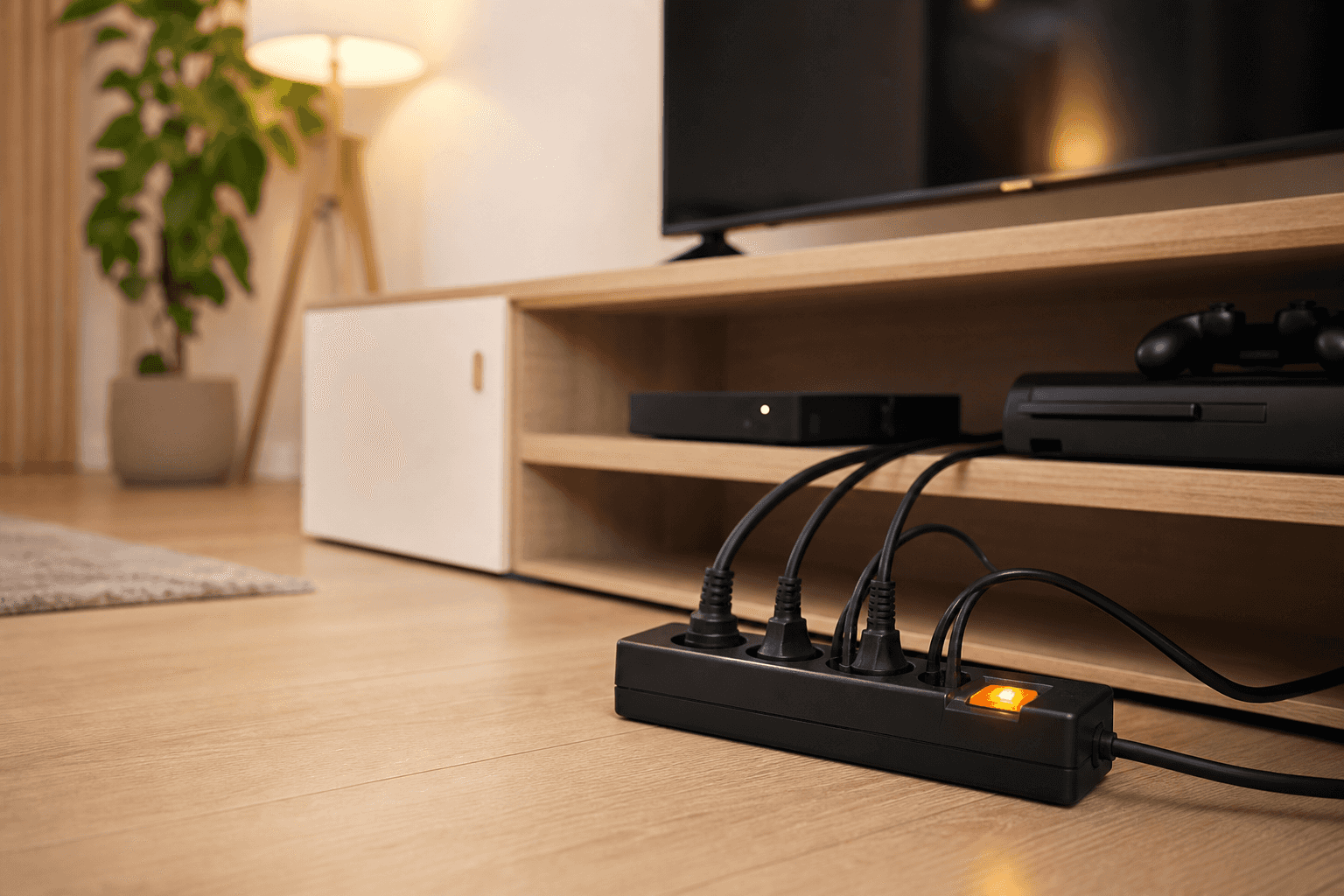
Forget the chargers. The high-value moves are few and mostly one-time. Open the game console's settings and turn off instant-on or rest mode, trading a few seconds of startup for a yearly saving. Set the desktop to sleep after 30 minutes. Put the TV, soundbar, cable box, and console on one power strip and switch it off at night, or use a smart strip that kills the peripherals when the TV goes dark. Unplug the second fridge if it is guarding three condiments and a sense of obligation. Swap an ancient rented set-top box for your provider's current low-power model.
That is the entire list. It will not recover $165, because $165 was never hiding in your chargers. It will more realistically claw back thirty to eighty dollars a year on the electronics, plus whatever the forgotten fridge was quietly costing, solid money for ten minutes of effort and nothing ongoing afterward. Anything past that is the simple pleasure of unplugging things, a fine hobby that does not show up on the bill.
So plug the toaster back in. Spend the ten minutes on the console setting and the garage fridge, and let the phone charger sip its quarter a year in peace. The energy vampires are real enough. They are just never the ones holding a flashlight to your face.