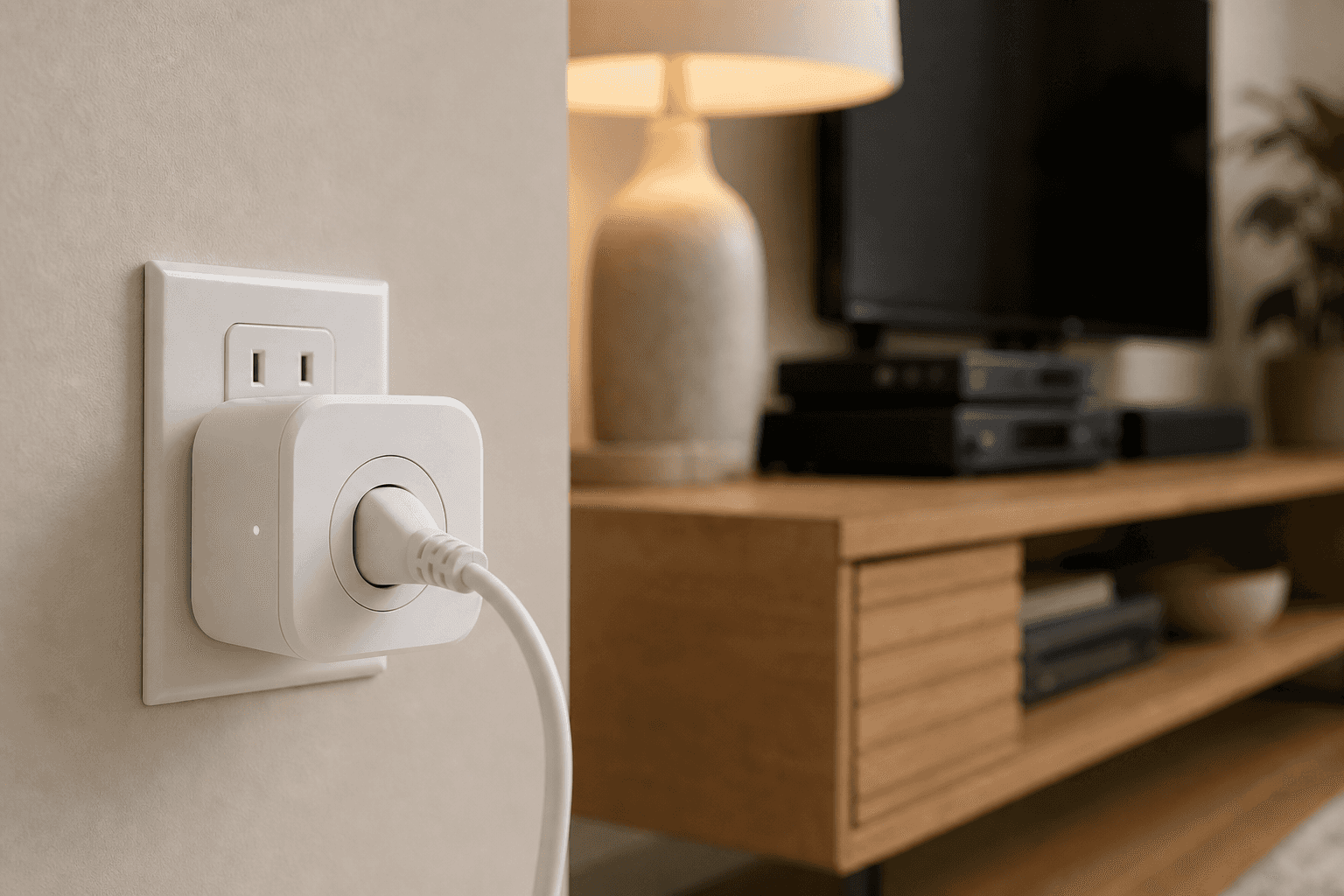
Key Takeaway
- A wifi smart plug draws about a watt around the clock just to stay connected, roughly $1.65 a year at the US average rate of 18.83 cents per kWh (EIA, March 2026). Any saving has to clear that toll first.
- Smart plugs only pay off at three jobs: cutting a TV and media stack overnight, scheduling a big appliance like a window AC, and a power-metering model that finds an energy hog you didn't know about.
- Pointed at a phone charger, nightlight, or LED lamp, a smart plug loses money forever. Those loads waste less than the plug itself burns.
- A TV stack can idle at 40 to 50 watts ($65 to $80 a year); a $7-to-$10 plug that kills it half the day claws back $30 to $40 and pays for itself in about three months.
- Scheduling a roughly 700-watt window AC for the hours nobody is home saves around $30 over a cooling season, more than a decade of policing phone chargers.
A wifi smart plug burns about a watt around the clock just to exist, call it $1.65 a year. Most of the things people point it at waste less than that.
Smart plugs sell in four-packs the way gym memberships sell in January, and for the same reason: the purchase feels like the accomplishment. The boxes promise lower bills, the top search results agree, and the real answer to "do smart plugs save electricity" is narrower than either suggests. A smart plug earns its keep at exactly three jobs: cutting power to the TV stack overnight, running a big dumb appliance like a window air conditioner on a schedule, and exposing an energy hog you didn't know you owned. Point one at anything else and the plug costs more to operate than it saves.
The arithmetic runs on one number. The US average residential electricity rate hit 18.83 cents per kilowatt-hour in EIA's March 2026 data, which prices a single watt of around-the-clock draw at about $1.65 a year. Keep that ratio handy, because the people selling smart plugs are counting on you not knowing it.
The plug spends a watt before it saves one
A wifi smart plug is a tiny computer holding a radio connection open all day, and that costs power. Manufacturer specs and independent estimates cluster around one watt of constant draw, from a few tenths of a watt on Zigbee and Z-Wave models to about two on some wifi units. Even MOES, a company that sells the things, pegs standby draw at roughly a watt, with its Zigbee and Z-Wave versions sipping 0.3 to 0.6. Call it $1.65 a year per plug, every year, before it has switched off a single thing.
That watt is the tollbooth every claimed saving has to pass. A plug that eliminates two watts of standby waste nets you one watt of progress, about $1.65 a year, on a gadget that cost ten dollars. The energy retailers writing the page-one blog posts on this topic skip the subtraction entirely; one of them calls a single watt of yearly savings a big deal in the same post that admits the plug itself draws one to two. Another page-one result promises as much as $20 to $60 a year on an electrician's word. Hitting even the bottom of that range means finding 12 watts of waste running around the clock behind a single outlet, and the top means 36. One spot in the house can supply that. Your charger drawer cannot.
Pointed at a phone charger, it loses money forever
An idle phone charger draws a fraction of a watt, and newer ones trickle along under a third. The most a smart plug can recover there is about 50 cents a year, usually far less, while spending $1.65 to exist: a guaranteed net loss before you even amortize the ten dollars of hardware. The same dead-end math covers nightlights, LED lamps, electric toothbrush chargers, and the toaster, which has no electronics and draws nothing in the first place.
Coffee makers are the honest gray zone. NRDC's 2015 home audits clocked them idling anywhere from under one watt to six. At the bottom of that range a smart plug is a money pit; at the top it recovers about $10 a year and pays for itself inside a year and a half. The catch is that you can't know which coffee maker you own without measuring it, which is an argument for a meter, not a switch.
The TV stack is the one standby target worth hitting
The living room is where standby watts actually pile up. The same 2015 audits put the average cable or satellite box at 16 watts around the clock, TVs at 13, audio gear near 8, and an Xbox One in instant-on mode added 12 more when NRDC measured it. A stack like that idles at 40 to 50 watts, which is $65 to $80 a year at today's rates for doing nothing. Newer gear idles leaner, which is one more reason to measure before assuming. Cut a stack like that off for the half of the day nobody is in the room and a single $7-to-$10 smart plug claws back $30 to $40 a year, paying for itself in about three months and then earning quietly for as long as the relay holds out.
Two caveats keep this honest. A DVR with its power cut records nothing, so the trick belongs in streaming-stick households, not homes with active cable recordings. And a dumb power strip with a rocker switch does the identical job for five dollars if you remember to flip it. The smart plug's entire pitch is that you won't.
Scheduling big appliances is where the real money hides
Standby is pocket change next to runtime. A mid-size window air conditioner draws somewhere around 700 watts while running, so every forgotten hour costs about 13 cents. Put it on a schedule that kills it for the four afternoon hours nobody is home and a single plug saves roughly $30 over a two-month cooling season. That is one plug, doing one job, beating a decade of charger-policing. The same logic fits dehumidifiers, towel warmers, and anything else high-draw that runs longer than anyone needs it to.
One safety note before somebody aims a plug at a space heater: a 1,500-watt heater pulls 12.5 amps, close to the 15-amp ceiling most smart plugs are rated for, and a cheap relay running near its limit for hours is a bad bet no matter what it saves. Read the rating stamped on the plug and the warnings in both manuals before pairing the two, or skip the pairing.
The version with a power meter is the only sure bet
Energy-monitoring smart plugs, the Kasa and Wyze and Meross models running $8 to $26, double as a wattage meter that never leaves the outlet. The readout is the feature that reliably makes money, because it finds the loads actually worth acting on: the coffee maker idling at six watts, the aging console pulling double digits in rest mode, the garage fridge from two houses ago. You don't need one per device, either. A single monitoring plug rotated around the house for a month audits everything suspicious for the price of a pizza. We ran the whole-house version of this exercise recently and landed in the same place: the savings come from information first, switching second.
One caution from a peer-reviewed test of five US models: their readings wobble on loads that spike and dip quickly, so treat the numbers as a guide rather than a lab instrument. For a verdict on the garage fridge, a guide is plenty.
Buy them as remote controls, not as investments
Smart plugs are good at being what they are: ten-dollar switches that turn lamps on at dusk, make the house look occupied while you're at the beach, and spare you a trip behind the couch. Convenience is a perfectly fine reason to own one, and nobody audits the payback period on convenience. Just don't buy the four-pack expecting the electric bill to notice. Aim one at the TV stack, one at the window AC, and one wattage-reading model at whatever you suspect, then stop. The phone charger was never the villain. It barely qualifies as an extra.