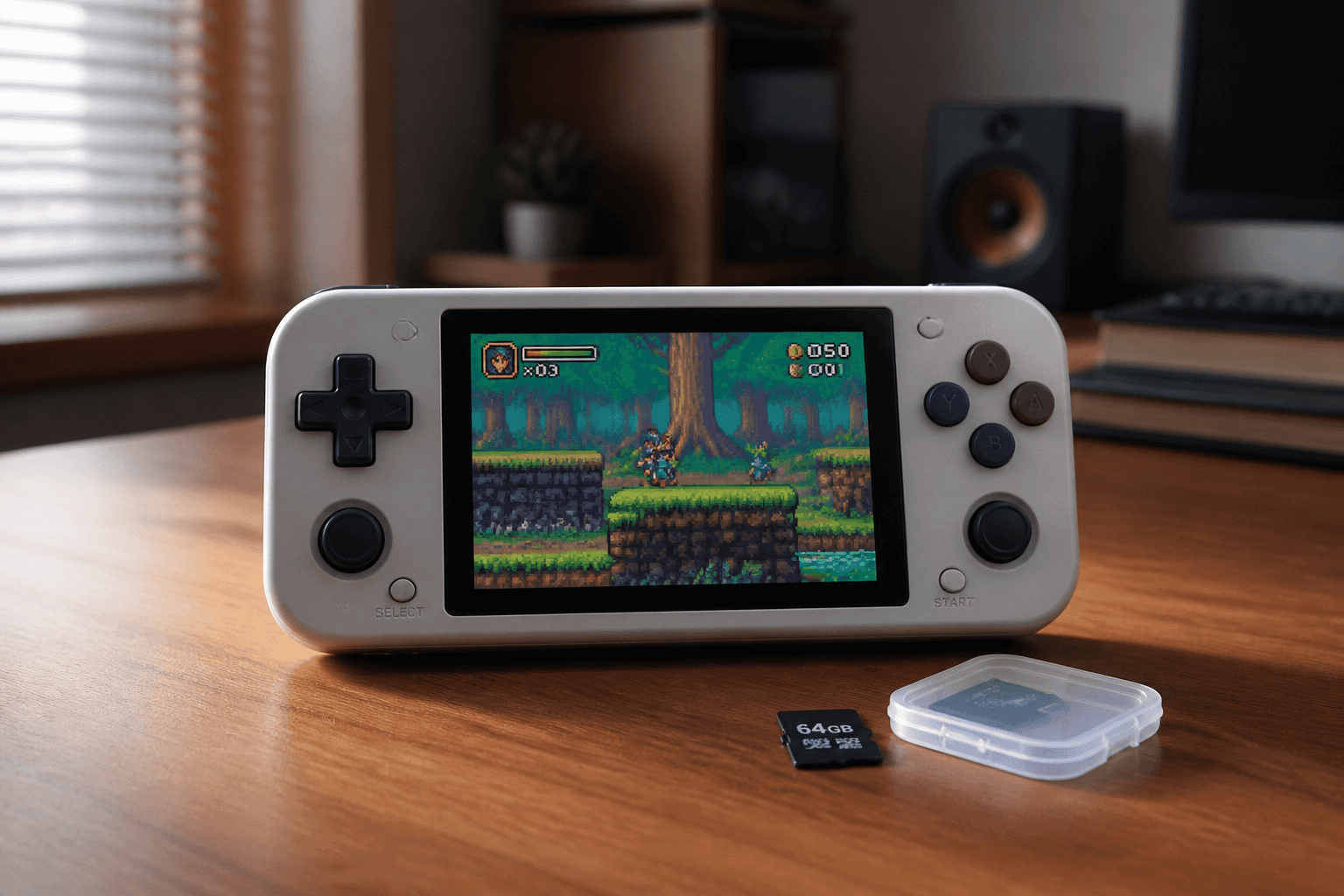
Key Takeaway
- The best retro handheld under $100 in 2026 is the Anbernic RG-35XX H at about $68. It plays everything through the PlayStation 1 era without complaint, handles Dreamcast and Nintendo 64 well, and has HDMI out plus the most mature custom firmware ecosystem in the price range.
- Spend about $90 on the AYANEO Pocket Air Mini if you want GameCube and Wii. A wave of cheap Android handhelds in late 2025 made that possible for the first time.
- PlayStation 2 remains out of reach under $100, and 3DS is marginal at best. The line has moved to GameCube; it has not moved further.
- The 5,000-games SD cards bundled with gift-market handhelds are unlicensed copies on failure-prone cards. Buy the clean device, buy a name-brand SD card, and load your own library.
- The floor: BATLEXP G350 at about $40. The GBA specialist: Anbernic RG-34XXSP at about $67. The budget PSP machine: TRIMUI Smart Pro S at about $90.
The affiliate lists crown a winner in fourteen categories because they get paid when any of them sells. There is one right answer for most people, one upgrade worth naming, and a games problem nobody in the search results wants to explain.
Every guide ranking these devices opens the same way: somebody claims they spent three weeks strapping fifteen consoles to a test bench, then declares all fifteen the best at something. One of the pages ranking for this search lives on a management company's website. So before naming the best retro handheld under $100, some honesty about method: Kinja did not bench-test these devices, and neither did most of the sites claiming they did. This is a synthesis of the people who verifiably do the testing, chiefly Retro Game Corps, the YouTube reviewer whose recommendations this entire hobby orbits, cross-checked against the r/SBCGaming community consensus that every credible list leans on.
That synthesis produces a short answer. For most people, the best retro handheld under $100 is the Anbernic RG-35XX H, at about $68. One upgrade is worth knowing about, one ultra-cheap option is worth naming, and the other eleven to nineteen devices on those mega-lists exist mostly so an affiliate link has somewhere to live.
| Device | Price | What it buys you |
|---|---|---|
| Anbernic RG-35XX H | ~$68 | The pick for most people: PS1 and below flawlessly, Dreamcast and N64 well, HDMI out, best firmware ecosystem |
| AYANEO Pocket Air Mini | ~$90 | The most powerful handheld under $100: adds GameCube and Wii, Hall Effect sticks, 4.2-inch screen |
| Anbernic RG-34XXSP | ~$67 | GBA-shaped clamshell with the correct 3:2 aspect ratio, the pick if Game Boy Advance is the whole point |
| TRIMUI Smart Pro S | ~$90 | Nearly 5-inch widescreen, the budget PSP machine |
| BATLEXP G350 | ~$40 | The floor: competent SNES and PS1, great buttons, no Wi-Fi, Bluetooth, or video out |
| Miyoo A30 | ~$49 | Truly pocket-sized, with a dim 2.8-inch screen and no headphone jack as the trade |
Why the answer is the Anbernic RG-35XX H
The RG-35XX H is a horizontal, PSP-shaped Linux handheld with a 3.5-inch screen, and it wins on the boring fundamentals. Per Retro Game Corps' current budget recommendations, it plays everything through the PlayStation 1 era without complaint, handles Dreamcast and Nintendo 64 well, and manages Nintendo DS respectably. That covers the overwhelming majority of what people actually mean by retro: NES, SNES, Genesis, Game Boy in all its flavors, arcade, and the PS1 library.
The device's real advantage is everything around the chip. It has HDMI out, so it doubles as a tiny console on a TV. It runs games ported from PC through PortMaster. And it sits inside the most mature community firmware ecosystem in the price range, with multiple polished custom operating systems maintained by people who do this for love. In this hobby, software support is the product; the plastic is just the delivery mechanism. Its honest weakness is the same one shared by the whole Linux tier: push past Dreamcast toward heavier systems and emulation gets unstable.
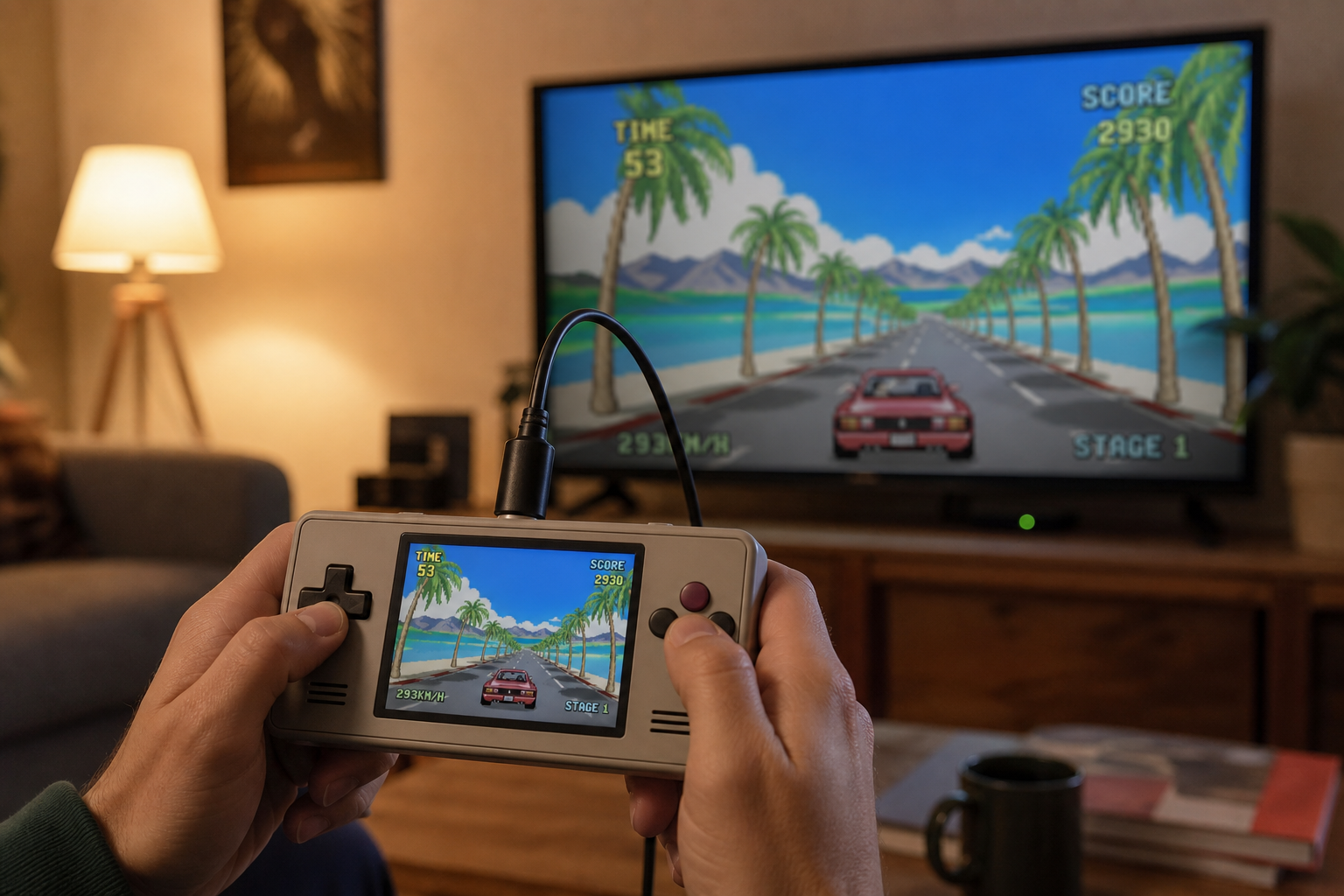
Anbernic sells a small army of near-identical siblings, vertical ones, bigger-screened ones, a square-screened one that Retro Game Corps personally favors for arcade and Game Boy. They are all fine. Buying the standard horizontal one and spending zero further minutes on the decision is the correct move.
Spend $90 if you want GameCube, because that just became possible
Here is where the guides ranking above this one go stale. Most still repeat the old rule that GameCube emulation under $100 does not exist, and until late 2025 that rule held. Then a wave of cheap Android handhelds landed between October and December 2025 and quietly moved the ceiling.
The one that matters is the AYANEO Pocket Air Mini, roughly $90, which Retro Game Corps' recommendations now rank as the most powerful handheld under $100. It runs GameCube and Wii well, a sentence that would have sounded like a typo at this price 18 months ago, and it adds Hall Effect analog sticks, a high-resolution 4.2-inch screen, and a big battery. The honest caveats: it ships with an aging version of Android, it has no video out, PlayStation 2 remains out of reach across the bracket, and 3DS is marginal at best. The line has moved to GameCube; it has not moved much further. Readers eyeing the fancier end of handhelds can see what real money buys in our guide to the best handheld gaming PC, and why it costs that much in why handheld gaming PCs are so expensive.
Android buys power and app access; Linux buys simplicity and better community firmware. A person who wants to put games on a card and play should stay with the $68 Linux answer. A person who enjoys fiddling, and who owns a soft spot for a certain purple cube (we ranked its controllers in every GameCube controller Nintendo ever made), should spend the extra $22.
Three honorable mentions and one warning about the $100 line
The floor is lower than most people expect. The BATLEXP G350, around $40, plays SNES and PS1 competently and has some of the best buttons in its price class, at the cost of Wi-Fi, Bluetooth, and video out; the pocket-sized Miyoo A30, around $49, makes its own trades with a dim 2.8-inch screen and no headphone jack. As a stocking stuffer or a glovebox console, the floor is defensible. As a primary device, the G350's missing Wi-Fi stings more than it sounds, because it locks out achievement syncing, box art, and easy file transfer.
Two specialists earn their category. The Anbernic RG-34XXSP, about $67, is a Game Boy Advance SP-shaped clamshell with the correct 3:2 aspect ratio, and it is the pick if GBA is the whole point. The TRIMUI Smart Pro S, about $90, carries a nearly 5-inch widescreen and is the budget PSP machine.
The warning: several lists crown the Mangmi Air X, an impressive 5.5-inch Android device, as the best budget handheld overall, and Retro Game Corps agrees it is excellent. It also costs about $100 on a good day, which makes it a strange winner for an under-$100 question and a fine answer to a slightly richer one. Budget picks that live exactly on the budget line have a way of drifting over it by checkout.
The pre-loaded games are the part nobody explains
Most of these devices, especially the gift-market ones, arrive with an SD card advertising 5,000 or 10,000 built-in games. The affiliate lists describe this as a feature and move on quickly, because explaining it kills the sale. So, plainly: the handhelds themselves are legal, and so are the emulators they run. The mountains of pre-loaded commercial games are unlicensed copies, sold by third parties who do not own them, curated with all the care of a landfill. Cards die, libraries are half broken, and the whole arrangement is the legal gray zone the industry politely declines to discuss.
The better path costs one evening. Buy the clean device, buy a name-brand SD card rather than trusting the one in the box, and load it with games you have a right to: dumps of cartridges and discs you own, and the large, excellent library of free-to-download homebrew and PC ports the community maintains. The device will run better, and the library will actually be yours.
The whole calculation lands in a friendly place. Sixty-eight dollars buys three decades of gaming in a pocket, ninety puts a GameCube in there too, and the only expensive mistake available is reading a 22-item list and buying four of them. Get the Anbernic, get a real SD card, and go be nine years old for a while.
Frequently asked questions
What is the best retro handheld under $100 in 2026?
The Anbernic RG-35XX H, at about $68. It plays everything through the PlayStation 1 era without complaint, handles Dreamcast and Nintendo 64 well, and manages Nintendo DS respectably. It also has HDMI out, runs PC ports through PortMaster, and sits inside the most mature community firmware ecosystem in the price range, which matters more than the plastic.
Can a retro handheld under $100 play GameCube games?
Yes, as of late 2025. The AYANEO Pocket Air Mini, roughly $90, runs GameCube and Wii well and is currently the most powerful handheld under $100, with Hall Effect analog sticks and a high-resolution 4.2-inch screen. The caveats: it ships with an aging version of Android and has no video out. Before that wave of cheap Android handhelds landed, GameCube emulation under $100 did not exist.
Can a retro handheld under $100 play PS2 games?
No. PlayStation 2 remains out of reach across the entire under-$100 bracket, and 3DS is marginal at best. The performance ceiling in this price range moved to GameCube and Wii in late 2025, but it has not moved much further. If PS2 is the goal, the budget for the device needs to roughly double.
Are the pre-loaded games on cheap retro handhelds legal?
The handhelds themselves are legal, and so are the emulators they run. The 5,000 or 10,000 pre-loaded games advertised on bundled SD cards are unlicensed copies of commercial games, sold by third parties who do not own them. The cards are also failure-prone and the libraries are typically half broken. The better move is buying the clean device, adding a name-brand SD card, and loading dumps of games you own plus free homebrew and community PC ports.
Should I buy a Linux or Android retro handheld?
Linux buys simplicity and better community firmware; Android buys raw power and app access. Someone who wants to put games on a card and play should take the $68 Linux answer, the Anbernic RG-35XX H. Someone who enjoys tinkering and wants GameCube and Wii performance should spend the extra $22 on the Android-based AYANEO Pocket Air Mini.