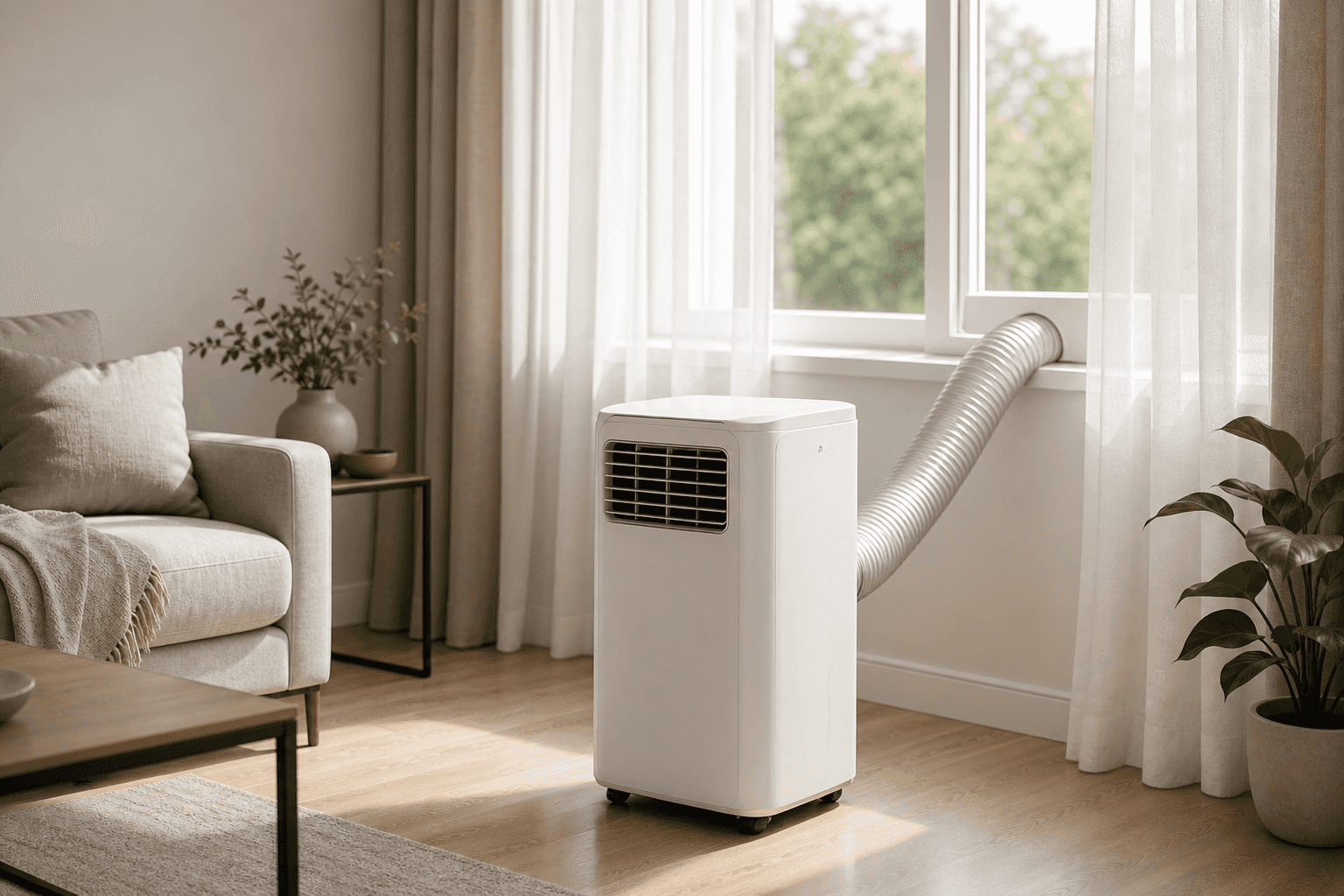
The appeal of portable air conditioners is obvious: no heavy unit balanced in your window, no landlord side-eye, no install beyond running a hose to the glass and rolling the thing where you need it. That convenience is real. It is also the only thing these machines do better than a window unit, and you pay for it twice, once at the register and again on every electric bill for as long as you own one. If you are asking whether portable air conditioners are worth it, the honest answer for most people is no.
Key Takeaway
- A single-hose portable air conditioner (the kind most people buy) creates negative pressure that pulls hot, unconditioned air into the room through every gap, fighting its own cooling. Dual-hose models largely fix this but are the minority on shelves.
- The big BTU number on the box is the old ASHRAE rating. The DOE's SACC rating reflects real cooling: a unit sold as "14,000 BTU" often delivers around 8,500 to 9,000 BTU, overstating cooling by a third or more.
- No portable air conditioner has ever earned an Energy Star. The certification program and federal efficient-purchasing rules specifically exclude them because the design cannot clear the bar.
- Portables cost more to buy ($400 to $600-plus versus $150 to $300 for a comparable window unit) and more to run, and the compressor sits in the room, so they are louder.
- A portable is the right call for casement or sliding windows, a room with no usable window, a rental or HOA that bans window units, spot cooling, or a short-term need. If you buy one, choose dual-hose, compare the SACC rating, and size it to the actual room.
The single hose fights the rest of the machine
Every air conditioner has to dump its heat somewhere. A window unit sits half outside and uses outdoor air to cool its hot coils, then throws that heat into the yard. A single-hose portable, which is what most people buy, has no outside half. It pulls air from inside your already-cooled room, runs it over the hot coils, and pushes it out the window through one hose.
That sounds harmless until you follow the air. Every cubic foot the unit shoves outside has to be replaced, and it gets replaced by hot, humid air sucked in through every door gap, window crack, and outlet in the room. Consumer Reports describes the result plainly: the negative pressure pulls "warm, unconditioned air from nearby rooms" into the exact space you are trying to cool. The machine ends up air-conditioning the outdoors a little and importing summer to make up the difference. Dual-hose models exist and largely fix this, but they are the minority on store shelves. Either way, the machine still has to sit next to a window to run its exhaust hose, so the room-to-room freedom the name implies is narrower than it sounds.
The big number on the box is not the real number
Portable air conditioners spent years advertised in inflated BTUs. The Department of Energy changed its test procedure to measure cooling the way you actually use it, and the new figure comes out a lot smaller than the old one. Manufacturers now print both: the older, higher ASHRAE number and the lower DOE number, often labeled SACC. That lower figure exists because the old bench test ignored two things you live with: the heat the exhaust hose sheds back into the room, and the conditioned air the unit loses out the window. SACC counts both.
The gap is not subtle. In hands-on testing, units sold as "14,000 BTU" landed around 8,500 to 9,000 BTU once measured by the DOE method, so the headline rating can overstate real cooling by a third or more. That shows up on a hot afternoon. One buyer found an 11,000 BTU portable could not cool a 300-square-foot bedroom, a room a similarly rated window unit would handle without complaint. When you shop, ignore the giant number on the front of the box and compare the DOE rating instead. Our guide to the best portable AC for an apartment bedroom walks through how to read those SACC numbers on real models.
No portable air conditioner has ever earned an Energy Star
This is the part the marketing leaves out. The Energy Star program, which certifies window and through-the-wall room units, specifically bars portables from earning the label. The Department of Energy's own efficient-purchasing rules for federal agencies do the same, carving portable air conditioners out of the room-AC category that government buyers are otherwise required to choose from.
That is not a paperwork accident. The most authoritative efficiency labels in the country won't put their name on a portable, because the design can't clear the bar. A common window unit posts an efficiency rating around 12 and wears the Energy Star badge; the portable beside it on the shelf qualifies for neither. You feel that gap as a unit that runs longer and pulls more power to deliver less cooling. Over a long cooling season that adds up, and it is money spent on the less efficient machine before you ever plug it in.
They cost more to buy and more to live with
Sticker price runs the wrong way too. Capable window units routinely sell for $150 to $300. Portables that cool a comparable space generally start around $400 and climb past $600, in exchange for worse performance.
Then there is daily life with one. The compressor sits in the room with you, so it is louder than a window unit whose noisy half hangs outside. It eats a chunk of floor space no matter how small the room is. Most models pull moisture from the air into an internal tank you have to drain, or a hose you have to route somewhere with a slope. And because a single-hose unit constantly draws unfiltered room air, its filter clogs faster. The word portable oversells things, too. Most units weigh 50 to 80 pounds and ride on casters, so they roll across a flat floor, not up a staircase. Even models that claim to evaporate their own condensate fill a tank you have to empty when the air is humid enough. No one of these is a dealbreaker. Together they describe a machine you tolerate rather than one you forget about. If humidity is your real complaint, our breakdown of whether you need an air purifier or a humidifier is a cheaper place to start.
When a portable actually makes sense
There is a real list of situations where a portable is the right call, and none of them is about cooling power. If your windows are the casement or sliding kind that a boxy window unit can't seal against, a portable may be the only thing that fits. The same goes for a room with no operable window near where you need relief, or a rental or HOA that flatly bans window units. For spot cooling, a stuffy home office, a server closet, one hot bedroom in an otherwise central-air house, a portable earns its keep as a supplement instead of the main event. A short-term need qualifies too: a renter between apartments, or a one-week heat wave in a climate that does not justify bolting anything into a wall.
If you land in one of those cases, buy smart. Choose a dual-hose model, which draws outdoor air for the coils and sidesteps most of the negative-pressure problem. Compare the DOE rating, not the ASHRAE one. And size it to the actual room, because an oversized unit chills the air before it can wring out the humidity, leaving a space that feels cold and clammy at the same time.
A window unit is cheaper, cools harder, runs quieter, and can earn an Energy Star a portable never will. The portable's one honest advantage is that it isn't bolted to your window. Buy one only when that is the thing you cannot live without. For more buying guides held to the same standard, browse our product reviews desk.
Frequently asked questions about portable air conditioners
Are portable air conditioners worth it?
For most people, no. A comparable window unit is cheaper to buy ($150 to $300 versus $400 to $600-plus), cools harder, runs quieter, and can earn an Energy Star rating that no portable qualifies for. A portable is worth it only in specific situations where a window unit will not work: casement or sliding windows, a room with no usable window, a rental or HOA that bans window units, spot cooling a single room, or a short-term need like a heat wave or a move between apartments. In those cases the portable's one real advantage, that it is not bolted into a window, is what you are paying the premium for.
Why is a portable AC weaker than its BTU rating suggests?
The big number on the box is the older ASHRAE rating from a bench test that ignored two real-world losses: the heat the exhaust hose sheds back into the room and the conditioned air the unit pushes out the window. The Department of Energy's SACC rating counts both, which is why it comes out much lower. In hands-on testing, units sold as "14,000 BTU" delivered around 8,500 to 9,000 BTU once measured by the DOE method, overstating real cooling by a third or more. Always compare the SACC or DOE figure, not the headline number.
Single-hose or dual-hose portable AC, which is better?
Dual-hose is clearly better. A single-hose unit draws air from inside the already-cooled room to vent its heat, which creates negative pressure that pulls hot, unconditioned air back in through every gap in the room, fighting its own cooling. A dual-hose model draws outdoor air through a separate intake to cool its coils, sidestepping most of that problem. The catch is that single-hose units dominate store shelves, so you usually have to seek a dual-hose model out specifically.
Why can't portable air conditioners earn an Energy Star?
The Energy Star program, which certifies window and through-the-wall room air conditioners, specifically excludes portable units, and the Department of Energy's efficient-purchasing rules for federal agencies do the same. It is not an oversight. The design, especially the single-hose configuration that loses conditioned air and sheds exhaust-hose heat back into the room, cannot meet the efficiency threshold. A typical window unit posts an efficiency rating around 12 and wears the badge; the portable next to it on the shelf qualifies for neither.
How many BTU do I need to cool my room with a portable AC?
Size to the room using the SACC rating, not the ASHRAE number, because the SACC figure reflects what the unit actually delivers. As a rough guide, a roughly 8,000 BTU SACC unit suits a small bedroom up to about 300 square feet, but check the manufacturer's SACC coverage rather than trusting the headline rating. Avoid oversizing: an oversized air conditioner chills the air before it can pull out enough humidity, leaving a room that feels cold and clammy at the same time. Right-sizing matters more with portables because they have less real capacity to spare.
Do portable air conditioners need to be vented out a window?
Yes. Every portable air conditioner has an exhaust hose that has to vent hot air outside, almost always through a window using an included panel kit. That requirement is why the name oversells the freedom: the unit still has to sit next to a window to run, so it rolls around a single room rather than truly going anywhere. Models that advertise no draining still need the exhaust hose, and units that claim to evaporate their own condensate still fill an internal tank you have to empty when the air is humid.