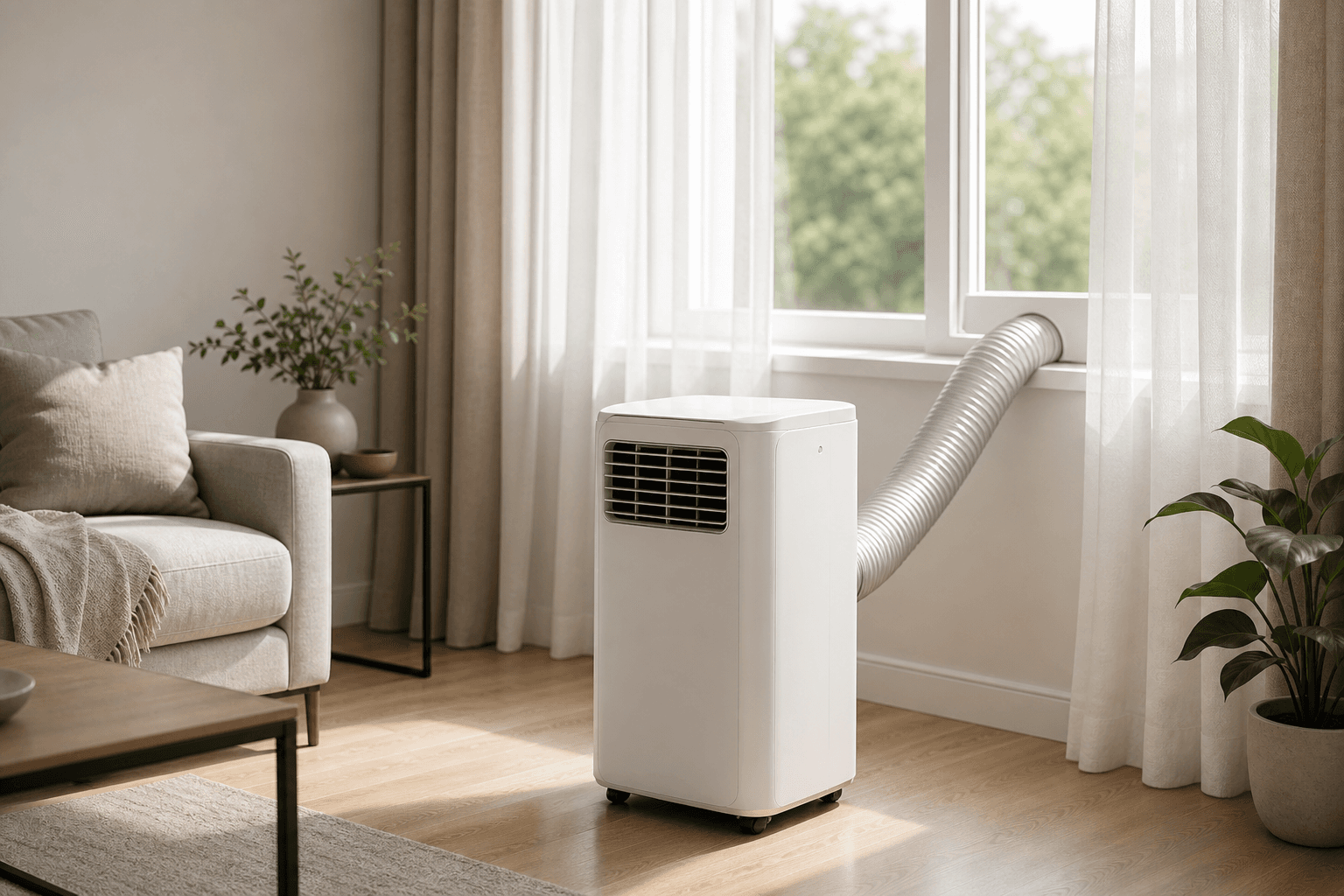
Most “best portable AC for bedroom” lists pick the same 14,000 BTU unit they recommend for a whole apartment. For a 200-square-foot bedroom, that's the wrong product. The real problem is the compressor.
The best portable AC for an apartment bedroom in 2026 is not the one most reviewers tell you to buy. Most “best portable AC” lists default to a 14,000 BTU unit (RTINGS' top-tested pick is the Whynter ARC-1230WN at 12,000 SACC), the same class of model they recommend for cooling an entire apartment. For a 150 to 250 square foot bedroom, this size of unit is overkill in a way that actively damages your sleep. The cooling capacity isn't the issue. The compressor is.
A traditional portable AC has a fixed-speed compressor that runs at full power until the room hits the set temperature, then shuts off completely. Then the room warms a few degrees, the compressor kicks on at full power, and the cycle repeats. In a small bedroom, this cycle takes 15 to 25 minutes. The compressor noise during the on phase is loud (often 55+ dB), and the silence during the off phase is what your half-asleep brain expects, so when the compressor kicks back on, you wake up. Three or four cycles a night is enough to ruin sleep quality even when the room temperature is fine.
The compressor cycling problem most reviewers don't address
The fix is an inverter compressor. Instead of running at full speed and shutting off, an inverter compressor runs continuously at variable speed, ramping up when the room warms and ramping down when it stabilizes. LG describes the difference in its own product literature: a non-inverter unit “turns the compressor either on or off to regulate temperature,” while an inverter unit modulates compressor motor speed to match the cooling load. Danby's manufacturer page makes the same engineering point, noting that inverter-driven compressors rarely shut off entirely.
The practical effect for sleep is dramatic. An inverter unit at sleep-mode speed produces a continuous 42 to 45 dB white-noise hum that your brain quickly tunes out. A fixed-speed unit cycles between 56 dB and silence, and that variation is what wakes you up. LG's testing claims its dual inverter portable AC saves up to 40% energy versus its non-inverter equivalent, but the bigger story for bedroom use is the noise floor, not the electric bill.
For bedrooms specifically, this means the 14,000 BTU recommendation defaults are wrong twice. They're too big for the room (so they cycle harder, hitting set temperature fast and shutting off), and most of them lack inverter compressors. The bedroom-correct unit is smaller, quieter, and almost always more expensive per BTU because the inverter compressor is a premium component.
Best overall: Midea Duo MAP12S1TBL
Midea's Duo at the 10,000 BTU SACC tier is the bedroom version of the unit recommended in apartment-wide guides. It's a dual-hose, inverter-driven portable AC rated for 450 square feet, with an advertised noise floor of 42 dB at low fan speed. Like the larger 12,000 SACC version, it uses a “hose-in-hose” design where the intake hose is nested inside the exhaust hose, which avoids the visual clutter of two separate hoses running across the floor.
The numbers that matter for a bedroom: 42 dB on low (per Midea's own spec page and Sylvane's product listing), inverter compressor (so no on/off cycling), and a 450 square foot rating that means it's not running at maximum to handle a 200 square foot room. Smaller load + variable speed = continuous quiet operation. Sam's Club and Walmart sell this unit, with current retail typically running $400 to $500 (Sam's Club listed it at $374 on a 2024 sale, so prices fluctuate).
If you want one unit that solves the apartment-bedroom cooling problem with the fewest compromises, this is it. If you also want zone-by-zone temperature control across the rest of the apartment, pairing it with a budget smart thermostat for the apartment handles the central system without you walking to a wall display every night.
Quietest single-hose alternative: LG LP1419IVSM
LG's “DUAL Inverter” naming is misleading: the unit is a single-hose portable, but with a dual-rotor inverter compressor (twin rotors inside the compressor, not two hoses). It's 14,000 BTU ASHRAE / 10,000 BTU SACC, rated for 450 to 500 square feet, and the spec sheet lists noise levels of 53/50/47/44 dB across high/mid/low/sleep modes.
The 44 dB sleep mode is the relevant number. Consumer Analysis tested this unit in a 150 square foot room starting at 90°F and clocked a 10°F drop in 10 minutes and a 15°F drop in 30 minutes, performance comparable to dual-hose 14K units despite the single-hose design. The reason it competes with dual-hose units in real-world testing is the inverter compressor maintains efficiency when the room is small enough that negative-pressure infiltration is limited.
LG's listed comp value is $699, but typical retail across Lowe's, Best Buy, and Sylvane runs $500 to $650. Buy this if the Midea Duo is sold out, if you don't want the visual presence of two hoses (the LG has one), or if you specifically want LG's ThinQ app integration.
Tiny bedroom budget pick: DREO 318S
If your bedroom is small (under 200 square feet) and you're not planning to run the AC for hours of pre-cooling, the DREO 318S is the budget option that still gets the noise floor low. It's 8,000 BTU ASHRAE / 5,000 BTU SACC, rated for 150 square feet specifically, with a 45 dB noise level. It runs around $439 at Home Depot and Best Buy.
The honest caveats on this pick: it's single-hose, it has a fixed-speed compressor (not inverter), and the 5,000 BTU SACC is the lowest cooling capacity among these picks. The reason it still works for tiny bedrooms is room size: in a 150 square foot space, the unit hits set temperature in 5 to 10 minutes, which means the cycling problem is brief and infrequent. The drainage-free auto-evaporation system also avoids the bucket-emptying chore that bigger units sometimes require.
This is the wrong unit for a 250 square foot bedroom or any room with poor insulation. It's the right unit for a tiny city bedroom where the alternative is sweating through a heatwave because every other model costs $500 plus. If air quality is also a concern in the same room, the trade-off between adding cooling, an air purifier, or a humidifier comes down to which one solves your specific bedroom symptoms; running all three rarely makes sense.
When the answer is a window unit
If your bedroom has a standard double-hung sash window, your building allows window installations, and you don't mind the install, an 8,000 BTU window unit will out-cool any portable on this list at lower cost and lower noise. LG and Frigidaire both sell 8,000 BTU window units in the $250 to $300 range that operate at noise levels comparable to or below the portables on this list. Window units don't have the dual-hose vs single-hose tradeoff because they exhaust directly outside.
The real reasons to pick a portable AC for a bedroom are the ones that haven't changed in years: casement windows that won't fit a window unit, building rules prohibiting external mounts, sliding windows that require special kits, or a rental where you can't make any modifications. In those scenarios, an inverter portable is the right answer.
For everyone else, the best portable AC for an apartment bedroom is whichever inverter unit your room size justifies. A Midea Duo at 42 dB on low, running continuously through a hot July night without cycling, is the difference between waking up at 3 a.m. drenched and waking up at 7 a.m. wondering why your alarm sounds annoying. The premium for an inverter compressor is real money, and for a bedroom, it's the only spec that matters more than BTU.
Frequently Asked Questions About Portable Bedroom ACs
Why do portable ACs wake me up at night?
Because most portable ACs use a fixed-speed compressor that runs at full power until the room hits set temperature, then shuts off completely, then kicks back on minutes later. The transition from a 55+ dB compressor noise to silence and back is what wakes a half-asleep brain, not the temperature. An inverter compressor avoids this by running continuously at variable speed.
How many BTU do I need for a bedroom?
For a 150 to 250 square foot bedroom, 8,000 to 10,000 BTU SACC is the right range. The common 14,000 BTU recommendations are sized for whole apartments and hit your bedroom's set temperature too fast, which makes the cycling problem worse. Smaller load plus variable speed equals continuous quiet operation.
Is an inverter portable AC worth the extra money?
For a bedroom, yes. An inverter unit runs at a steady 42 to 45 dB white-noise hum your brain tunes out, while a fixed-speed unit cycles between 56 dB and silence. LG also claims its dual inverter portable saves up to 40% energy versus the non-inverter equivalent, but the noise floor matters more than the electric bill for sleep.
Dual-hose vs single-hose portable AC: which is better?
Dual-hose units are more efficient because they don't pull conditioned air out of the room and create negative pressure. In larger rooms, the difference is significant. In a small bedroom, an inverter single-hose unit like the LG LP1419IVSM can match dual-hose performance in real-world testing because the small room limits how much warm air leaks back in.
How loud is 42 dB actually?
About the level of a quiet library or a soft refrigerator hum. It is below normal conversation (around 60 dB) and well below a loud window unit at 55 to 60 dB. Most importantly, a 42 dB inverter unit produces a constant tone, which the brain treats as background noise rather than an alerting sound.
Should I get a window unit instead?
If your bedroom has a standard double-hung sash window, your building allows external mounts, and you don't mind the install, an 8,000 BTU window unit at $250 to $300 will out-cool any portable on this list at lower cost. Pick a portable instead if you have casement or sliding windows, building rules prohibit window mounts, or you rent and can't make modifications.
What is the difference between BTU and SACC?
BTU (specifically ASHRAE BTU) is the older rating that overstates real-world cooling capacity. SACC (Seasonally Adjusted Cooling Capacity), required since 2017, accounts for portable AC inefficiencies like duct heat loss and infiltration, and is the more accurate number to size by. A unit advertised at 14,000 BTU ASHRAE typically has a SACC rating around 10,000 BTU.