Key Takeaway
The average American spends $3,526 a year on takeout. Meal preppers spend $3-5 per serving and save 6-8 hours a week. The difference isn't talent or ambition. It's a system that takes two hours and a sheet pan.
The meal prep content on Instagram and YouTube makes the whole endeavor look like a competitive sport. Sixteen matching glass containers. Color-coordinated vegetables. A week's worth of meals that look like they belong in a cookbook, photographed on a marble countertop by someone who definitely doesn't have a full-time job and two kids.
That version of meal prep is aspirational, beautiful, and completely unsustainable for normal humans. The version that actually works is uglier and simpler: cook a big batch of protein, a big batch of grain, and a big batch of vegetables on Sunday afternoon. Mix and match throughout the week. Eat the same lunch three days in a row. Accept that your Tuesday dinner will look a lot like your Wednesday dinner. Survive.
The data backs up the boring approach. People who meal prep save an average of 6-8 hours per week on food preparation, according to research on batch-cooking habits. They spend $3-5 per serving instead of $12-20 for takeout. They eat 23% more vegetables and 18% less processed food than non-preppers, and they lose an average of 6.2 pounds over 12 weeks without specifically trying to diet. That last number makes sense once you think about it: meal prep means making rational food decisions once a week (Sunday, when you're calm and fed) instead of emotional, hunger-driven decisions five times a day (Tuesday at 6pm, when you're exhausted and the DoorDash app is right there).
The math that makes meal prep worth it even if you hate cooking
The average American household spends $3,526 annually on food away from home, according to BLS data. Converting even half of those meals to home-cooked prep saves roughly $1,300-1,700 per year, using conservative $3-5 per serving estimates for batch cooking.
Then there's food waste. The average American wastes about 31.9% of the food they purchase. That means roughly a third of your grocery bill ends up in the trash. For a household spending $500/month on groceries, that's $160/month in garbage. Meal preppers, because they plan exactly what they'll cook and when they'll eat it, reduce waste to under 5%. On a $500 monthly grocery budget, that's $135/month saved just by not throwing food away. Over a year: $1,620.
Combined savings from reduced takeout and reduced waste can easily hit $200-250/month for a two-person household. That's $2,400-3,000 per year. A week's worth of meal prep containers costs about $25.
The Sunday system that takes two hours, not five
Most meal prep advice overwhelms people with elaborate recipes that require 15 different ingredients and three hours of active cooking. The system that sticks is much simpler. It has three steps, uses one sheet pan and one pot, and produces enough food for roughly 12-15 servings (covering lunches and dinners for most of the week for one or two people).
Step 1: Cook two proteins. Pick two. Not four. Not six. Two. The easiest combination: season 3-4 pounds of boneless chicken thighs (cheaper and more forgiving than breasts) with olive oil, salt, pepper, garlic powder, and paprika. Spread them on a sheet pan and bake at 400 degrees for 25-30 minutes. While those cook, brown 2 pounds of ground turkey or beef in a skillet with onion, garlic, cumin, and chili powder. Total hands-on time: about 15 minutes. Total oven/stove time: 30 minutes.
When the chicken is done, you have protein for grain bowls, salads, wraps, and stir-fries. When the ground meat is done, you have filling for tacos, burritos, pasta sauce, and stuffed peppers. Two proteins, ten possible meals.
Step 2: Cook two grains or starches. A rice cooker handles this without attention. Make 4 cups of rice (which yields about 8 cups cooked) and a batch of quinoa or roasted sweet potatoes. Rice takes 20 minutes in a cooker. Sweet potatoes, diced into cubes, take 25 minutes on a sheet pan at 400 degrees alongside (or after) the chicken. If you don't own a rice cooker: buy one. A basic model costs $25 and removes the single most annoying variable in home cooking (rice that's somehow both crunchy and soggy).
Step 3: Prep three vegetables. Raw vegetables that hold up for 3-5 days in the fridge: bell peppers (sliced), cucumbers (sliced), cherry tomatoes (washed, left whole), carrots (peeled and cut into sticks), and broccoli (cut into florets). Roasted vegetables that reheat well: broccoli, Brussels sprouts, zucchini, and cauliflower, all tossed with olive oil and salt and roasted at 400 degrees for 20 minutes.
Total active time: about 30 minutes of chopping and seasoning. Total passive time (oven, rice cooker): about 45-60 minutes. Grand total: roughly two hours, including cleanup, with food for 12-15 meals.
The assembly strategy that keeps you from getting bored
The secret to not hating your meal prep by Thursday is treating the components as a LEGO set, not a finished meal. You cooked chicken, ground meat, rice, sweet potatoes, and three vegetables. Now you build different combinations every day:
Monday lunch: Chicken + rice + roasted broccoli + sriracha. Monday dinner: Ground meat + tortilla + raw bell peppers + salsa + cheese.
Tuesday lunch: Chicken + quinoa + cucumbers + cherry tomatoes + olive oil and lemon (instant grain bowl). Tuesday dinner: Ground meat + rice + black beans (from a can) + corn + cumin (burrito bowl).
Wednesday lunch: Leftover burrito bowl, reheated. Wednesday dinner: Chicken, shredded, mixed into jarred marinara sauce over pasta (cook the pasta fresh; it takes 10 minutes).
Each "meal" takes under 5 minutes to assemble because the cooking is already done. The variety comes from sauces, seasonings, and add-ons: a drizzle of tahini turns a grain bowl into something Mediterranean. A splash of soy sauce and sesame oil makes the same rice and chicken feel Japanese-adjacent. A handful of shredded cheese and a scoop of sour cream makes it Tex-Mex. Same ingredients, different flavor profiles, minimal effort.
The five sauces that make meal prep not taste like meal prep
Plain chicken and rice five days in a row is a punishment, not a meal plan. The difference between "I prepped my lunch" and "I genuinely enjoy this" usually comes down to one condiment. Keep these five in your fridge at all times and you can make the same base ingredients taste different every day:
Sriracha or chili crisp. Chili crisp (the Lao Gan Ma jar with the woman's face on it) is the single best thing you can add to reheated chicken and rice. About $4 and it lasts weeks.
Tahini. Mix with lemon juice and a splash of water to make a dressing. Drizzle over any grain-and-vegetable combination for an instant Mediterranean bowl.
Soy sauce + sesame oil. A tablespoon of each turns rice, vegetables, and chicken into something that tastes like a stripped-down stir fry.
Salsa (jarred is fine). The laziest flavor upgrade: dump salsa on anything with ground meat and cheese For more, see You Don't Need 600 Dinner Recipes..
Italian dressing or vinaigrette. Pour it over chicken, vegetables, and grains for a cold lunch that doesn't need reheating. Surprisingly effective and chronically underrated in meal prep circles.
The container situation (it matters more than you think)
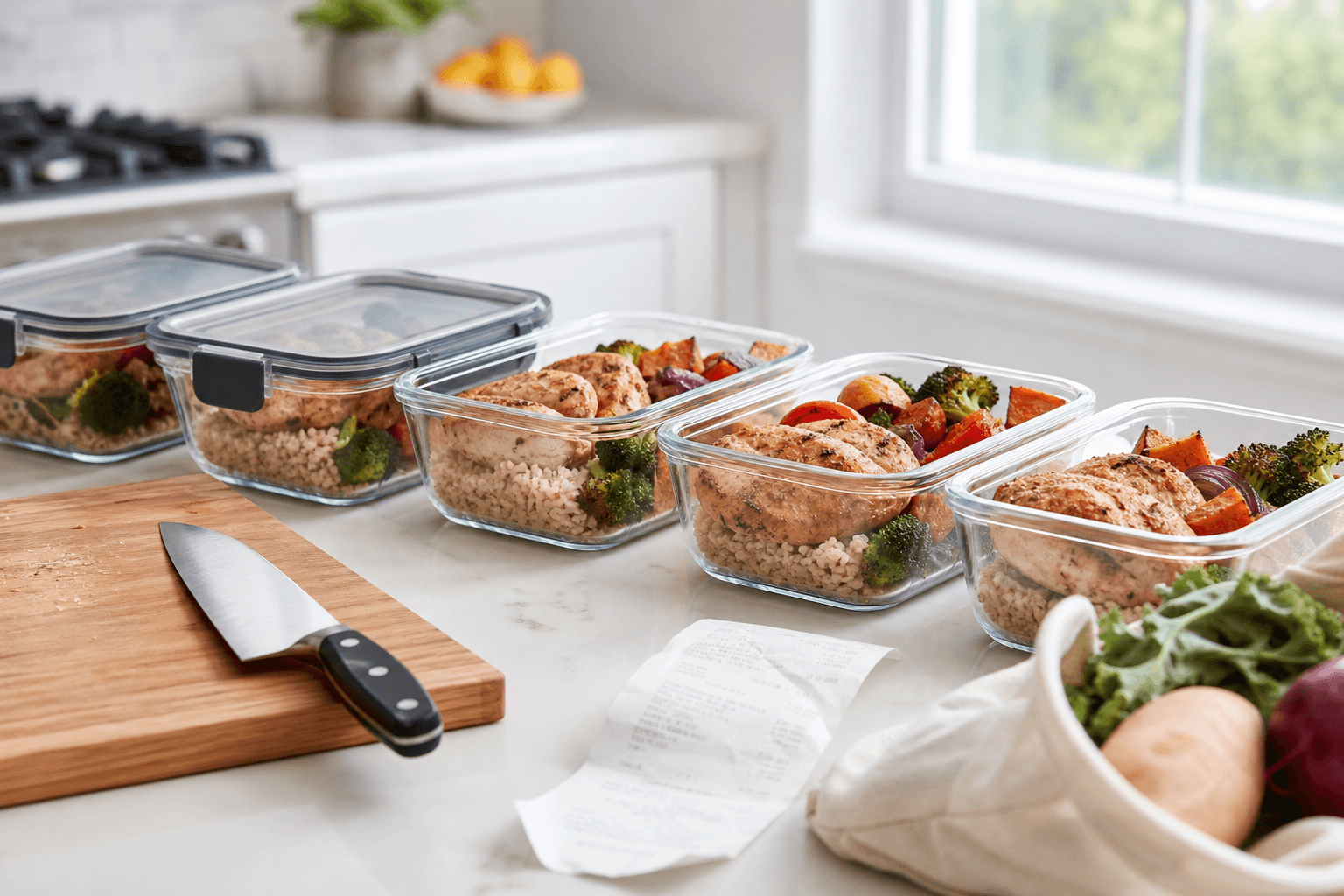
Glass containers with snap-lock lids are worth the money. A set of 10 costs $25-35 and will last years. Plastic containers stain, absorb odors, warp in the microwave, and eventually make everything taste vaguely like last week's curry.
The ideal meal prep container has two or three compartments (so wet and dry ingredients don't mingle before you're ready to eat), is microwave-safe, is dishwasher-safe, and stacks neatly. Pyrex, Rubbermaid Brilliance, and Prep Naturals all make solid options in the $25-35 range for a 10-pack.
Label your containers with the day you made the food. Most cooked proteins, grains, and roasted vegetables last 3-4 days in the refrigerator at 40 degrees. Soups and stews also last 3-4 days. Cut raw vegetables hold for 3-5 days. Anything you won't eat within four days should go straight into the freezer, where most prepped meals last 2-3 months.
The high-protein variation for the gym crowd
The protein-everything trend has reshaped how a lot of people think about meal prep, particularly people on GLP-1 medications who need to maximize protein to preserve muscle mass on reduced calories (we wrote about GLP-1 drugs and how they work).
A high-protein meal prep week looks like this: swap the rice for cauliflower rice (21 calories per cup vs. 206 for white rice), double the chicken and ground turkey portions, add a batch of hard-boiled eggs (make 12 at a time; they last 5 days in the fridge), and swap one grain for a can of black beans or chickpeas (about 15g protein per cup).
A single serving of chicken thigh (4oz) provides roughly 26g of protein. A hard-boiled egg adds 6g. A half-cup of black beans adds 7.5g. A high-protein prep bowl with all three hits 40g of protein per meal, which is in the range most dietitians recommend for adults aiming to build or maintain muscle For more, see High Protein Recipes for People Who Are Tired of Eat.....
Scaling up for families without losing your mind
Meal prep for a family of four isn't four times the work; it's roughly 1.5 times the work. You're still cooking the same two proteins and two grains. You're just making more of each.
For a family of four: 5-6 pounds of chicken thighs (instead of 3-4), 3 pounds of ground meat (instead of 2), and 6 cups of rice (instead of 4). The vegetables scale linearly. The total time goes from about 2 hours to about 2.5 hours, mostly because larger quantities take slightly longer to cook and you'll need a second sheet pan.
The USDA's thrifty food plan estimates a family of four can eat nutritiously for about $1,003/month in 2026 (approximately $233/week). A meal prep approach built around bulk proteins, rice, beans, and seasonal vegetables can come in well under that number. A week of lunches and dinners for four people, using the system above, costs roughly $60-80 in groceries depending on your local prices and whether the chicken is on sale.
Shopping with a list reduces impulse purchases by 73%, according to consumer research. That alone can save $40-60 per month for the average household. Combine it with buying proteins in bulk when they're discounted (freeze what you don't use immediately) and planning your vegetable choices around what's in season, and the savings compound.
The mindset shift that makes all of this stick
Meal prep fails for one reason more than any other: people try to make it interesting. They search Pinterest for "exciting meal prep ideas" and end up with a grocery list that has 47 items, three of which they've never cooked with before, and a Sunday afternoon that lasts until sundown.
The people who sustain meal prep for months and years are the ones who accept repetition. They eat the same lunch four days a week. They rotate through the same six or seven dinners. They understand that the point isn't to have a restaurant-quality experience at every meal. The point is to eat well, spend less, waste nothing, and save enough time during the week to do the things that actually make life interesting.
Two hours on Sunday. Five ingredients. Three sauces. A stack of glass containers. That's the whole system. It's not glamorous. It works.