Key Takeaway
- Buy the power rack. Free-weight squats recruited 43 percent more muscle than the same lift on a Smith machine at working weights (University of Saskatchewan, 2009).
- A complete rack-based gym (rack, bar, bench, plates) starts around $500. The all-in-one Smith machines testers actually recommend run $700 to $3,000 and often ship without a bar or plates.
- Every comparison guide ranking for this search is an equipment store that sells both machines, so none of them will call one the wrong buy.
- Smith bars weigh anywhere from 6 to 45 pounds depending on the brand, so your training numbers do not transfer. A standard Olympic barbell is 45 pounds in every gym.
- Buy the Smith machine only if you are rehabbing an injury, need a fixed path to actually show up, or want it as an accessory alongside a rack you already own.
A free-weight squat recruits 43 percent more muscle than the same lift on rails. Every guide ranking for this question is written by a store that sells both machines, which is why none of them will say so plainly.
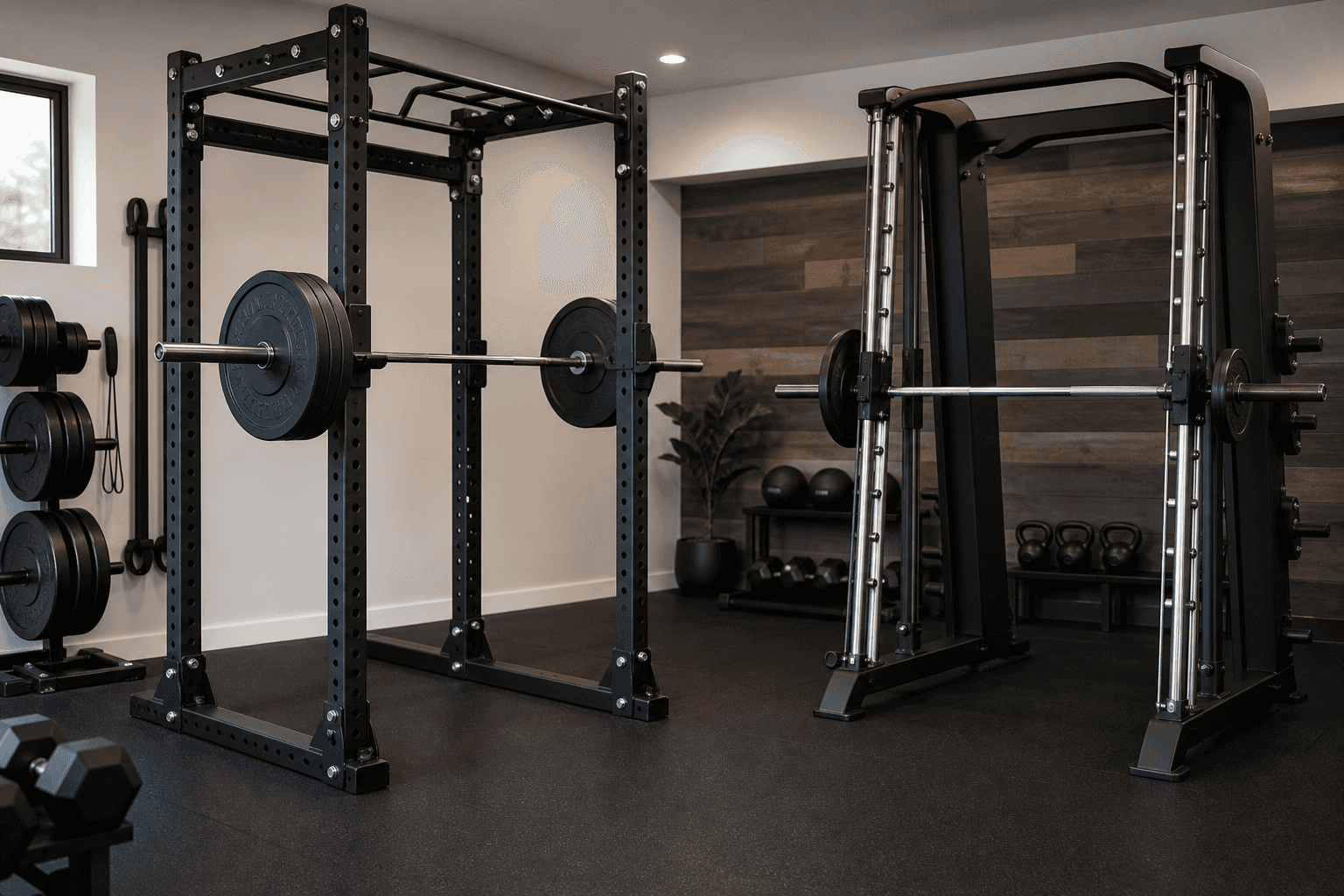
Settle the Smith machine vs power rack for home gym question with one sentence: buy the power rack. The muscle research favors it at working weights, a complete rack setup costs about what an incomplete Smith frame costs, and a real barbell is a standardized 45 pounds while Smith bars weigh anywhere from 6 to 45 pounds depending on the brand. There are people who should buy the Smith machine anyway, and they get their section below. Everyone else can stop reading comparison guides written by companies with a Smith machine sitting in inventory.
Every guide ranking for this question sells both machines
Run the search yourself. Page one is RitFit, Mikolo, Fray Fitness, RitKeep, Fitness Superstore, and their peers: equipment stores, every one, with both products in the catalog. A store that sells both machines cannot tell you one of them is the wrong buy, so every guide lands on the same shrug. It depends. Consider your goals. Both are great.
Read their fine print instead. Mikolo, which would happily sell you either, admits in its own guide that "the Power Rack is usually the most complete choice" for a first purchase. A Smith machine buying guide at Home Gym Verdict cites the muscle-activation research below and concludes the Smith complements a barbell rather than replaces one. When the people selling the thing describe it as an accessory, believe them.
The muscle research is not close at working weights
The study everyone in this argument eventually cites came out of the University of Saskatchewan in 2009. Six trained lifters squatted an 8-rep-max load two ways, free bar and Smith machine, with electrodes on seven muscles. Averaged across all of them, the free-weight squat produced 43 percent more muscle activity. Three muscles hit statistical significance on their own: the gastrocnemius at 34 percent more, the biceps femoris at 26, and the vastus medialis at 49. The rails were doing work your legs should have been doing.
Fair reporting requires the caveats. Six lifters is a small study. At light loads the picture gets murkier: one follow-up found more vastus lateralis activation on the Smith machine at 60 percent of body weight, and a fixed path lets most people move heavier absolute loads, about 5 percent more on squats in one comparison. Matched for effort, machines grow muscle about as well as free weights do. So the Smith machine is not useless. It just trains you to be strong on a Smith machine, and strength sticks to the implement you practice. The barbell is the implement every other gym, program, and platform on the planet uses.
The price sheet is a rout
Line up what the money actually buys, using current prices from independent testers rather than the vendors.
| Path | Entry cost | What you actually get |
|---|---|---|
| Power rack | $329 (Fitness Reality 810XLT) to about $450 (REP PR-1000) | The rack; complete published kit-lists with bar, bench, and plates start around $500 |
| Rack with cables | $489.99 (Mikolo F4 2.0) | Rack plus a dual pulley system, under $500 |
| Smith machine, entry | About $500 (Marcy) to under $600 (RitFit) | A guided-bar frame, frequently shipped without bench, barbell, or plates |
| Smith machine, recommended | $700 (Major Lutie) to about $3,000 (Force USA G10 Pro) | The all-in-ones testers actually endorse; the category runs $2,000 to $6,000 |
An entry rack assembles in about two hours. The dedicated Titan Smith machine carries a labeled 5-hour assembly that BarBend's tester says to budget a full day for, with professional assembly available for another $800, on a machine with a 1-year warranty. Force USA's flagship arrives as 1,000-plus pounds of parts in two crates; the testers at Strong Home Gym built theirs over three weekends. The rack path hands you a complete gym for around $500. The recommended Smith path costs 3 to 6 times that before a single plate is on the floor.
Steel has no moving parts. A rack is four uprights and some pins, which is why a decade-old one still works like a new one. A Smith machine is rails, bearings, a carriage, and usually a pulley stack, and every one of those is a wear item you'll be moving down a staircase someday.
The Smith bar lies to your training log
A standard Olympic barbell weighs 45 pounds in every American gym. Smith machine bars weigh whatever the manufacturer decided: 16 pounds on most Marcy machines, 15 on Nautilus, 25 on several commercial brands, up to 45 on others, with counterbalanced carriages commonly starting at 15 to 25 pounds of felt weight. A counterbalanced carriage lightens the felt load, so the plates on the bar overstate the work you did. The Smith guides' own advice is to weigh your empty bar before trusting any number on your log. Squat 225 on rails for a year and you have squatted some amount of weight, on that machine, in that garage. The number does not travel. Free-weight numbers do, to any gym, any program, and any beginner routine worth following.
The safety argument is mostly marketing
Guided rails feel safer, and for a nervous first-timer they are, in the way training wheels are. But the vendors concede the mechanical point in their own FAQs: a power rack with safety pins set correctly catches a failed rep just as reliably, and Mikolo's own guide frames the gap as a matter of control rather than protection. Set the pins an inch below your bottom position and the worst squat of your life ends with a clang instead of a crisis. The rack is boring. Boring wins.
Buy the Smith machine anyway if
Three groups get real value from the rails. Lifters rehabbing an injury who need a fixed path while a joint relearns its job. Solo beginners who know themselves well enough to know a free bar means they will skip leg day entirely; the lift you actually do beats the superior lift you avoid. And dedicated hypertrophy trainees who want the Smith for controlled accessory volume on top of an existing rack, which is exactly the complement role the Smith guides describe. What has stopped making sense is buying a $2,000 all-in-one for the cable stack, now that a $490 rack ships with pulleys built in.
Picking one machine and committing beats owning neither (the same logic settled our treadmill or elliptical call). But this one isn't close. Buy the rack, spend the leftover thousand on plates and a decade of not thinking about it, and let the machine with the training wheels stay at the commercial gym where somebody else maintains it.