Key Takeaway
- The build serious home golfers assemble costs about $5,000. Vendor cost guides quoting $7,000 to $18,000 are pricing the packages they sell, not the parts.
- Spend 40 to 60 percent of the budget on the launch monitor, because tracking accuracy caps everything else. 2026 clearance on the FlightScope Mevo+ and certified pre-owned SkyTrak+ makes mid-tier monitors unusually cheap.
- Software is the recurring cost package quotes hide: GSPro runs $250 a year, and a Bushnell Launch Pro adds a $499-a-year plan on top of the monitor.
- The real competitor is a simulator lounge at about $50 an hour. A $5,000 build breaks even around year three for a weekly player, but a 20-hour-a-year golfer should just rent.
- The room is part of the price: you need a 9-foot ceiling (10 to 11 preferred), 12 to 15 feet of width, and 15 to 18 feet of depth. If your ceiling is 8 feet, the honest answer is $45 an hour.
The vendor guides quote $7,000 to $18,000. The build that dominates the golf simulator forums costs about five grand, and the line item every package quote leaves out renews annually.
Ask a store how much a home golf simulator costs and the answer is whatever their flagship package sells for. The honest version has three numbers. A functional starter runs $1,000 to $2,500. The build serious home golfers actually assemble lands near $5,000. And the $7,000-to-$18,000 packages on page one of your search results exist for people who never priced the parts. There is also a fourth number nobody selling hardware will hand you: $45 an hour, which is what a simulator lounge charges and which decides whether you should build anything at all.
The stores quoting $18,000 are answering a different question
Every cost guide ranking for this search is published by someone with inventory: Carl's Place, aboutGolf, ProSimHQ, and a rotation of installers. ProSimHQ's guide states that "most complete setups range from $7,000 to $18,000." Carl's Place pegs a realistic simulator at $3,000 to $20,000 and warns that golfers regret the under-$1,000 route. An installer in the same results frames the category as $1,500 to $70,000, a range so wide it prices a used Honda and a small house addition in the same sentence.
None of this is lying, exactly. It is retail gravity. A store's cost guide anchors to the packages the store would like to sell, and packages bundle margin. Price the components the way the hobbyist forums do and the number falls by half or more.
The three honest price tiers
Here is where the money lands in 2026, using component prices from independent testers rather than package pages. One planning rule those testers agree on: the launch monitor should eat 40 to 60 percent of the budget, because tracking accuracy is the ceiling on everything else in the room.
| Tier | What it is | Real cost |
|---|---|---|
| Starter | Garmin Approach R10 ($499) or Rapsodo MLM2PRO ($699), a net and mat, the tablet you already own; add a budget screen and projector to reach the top of the range | $1,000-$2,500 |
| The forum build | FlightScope Mevo+ on clearance ($1,099-$1,499), Carl's Place enclosure ($800-$1,500), BenQ short-throw projector ($700-$1,500), quality mat ($200-$350), gaming PC ($800-$1,900) | $3,600-$6,750 |
| The package tier | Photometric monitors like the Bushnell Launch Pro ($2,499), branded enclosures, professional installation | $7,000-$18,000 |
The starter tier works, with an asterisk the ads skip: radar units struggle with spin indoors, and independent testing finds they flatter your score by 10 to 15 strokes. Fine for winter swings, misleading for real improvement.
The middle row is the most popular build pattern on the golf simulator forums for a reason, and 2026 is a strangely good year to buy it. FlightScope put the Mevo+ in clearance after launching the Mevo Gen2 at $1,199, and SkyTrak discontinued new SkyTrak+ units when the ST MAX arrived at $2,995, so certified pre-owned SkyTrak+ monitors now sell direct for $1,495 to $2,495. Two accurate mid-tier monitors got cheaper at once. No vendor cost guide on page one mentions it.
Software is the cost every package quote omits
A simulator without software is a radar pointed at a net. GSPro, the community-standard course software, lists at $250 per year, which buys access to a user-built library more than 2,000 courses deep. Some monitors add their own required plan on top: running GSPro on a Bushnell Launch Pro takes the $499-per-year Gold subscription, a second line item that turns a $2,499 monitor into a $2,499 monitor with a car payment. The cost hub at Golf Simulator Source ran the five-year math: add the software line to a $10,000 build and the true bill lands between $11,500 and $13,000. The sticker is roughly three-quarters of the five-year bill.
Budget the computer too. GSPro needs a Windows gaming PC, roughly $800 to $1,900 depending on how pretty you want Pebble Beach to look. The tablet-only tiers dodge this cost, which is part of why they cost a tier less.
The break-even math against renting a bay
X-Golf's published rates run $45 an hour on weekdays and $65 on weekends for a bay that seats up to six, and MyGolfSpy's national survey puts most venues between $20 and $80 an hour. Call it $50. Now the arithmetic no equipment vendor will print.
A $5,000 build plus $250 a year in software, against $50 an hour rented: a golfer who plays two hours a week through a 22-week northern winter buys 44 lounge-hours a year, about $2,200. The home build breaks even during year three and prints money afterward. Play three hours a week year-round and it pays for itself inside nine months. But a casual golfer logging 20 hours a year would need almost seven years to break even, and no seven-year-old launch monitor will be the one you want. At that usage, rent the bay and let the lounge eat the depreciation. Renting also scales down well in company, since the price is per bay: a $60 weekend hour split four ways runs $15 a head.
The membership wrinkle cuts the other way. Unlimited metro memberships start around $200 a month, which sounds efficient until you multiply: even that floor runs $12,000 over five years, against $6,250 for owning the forum build outright. Heavy players pay roughly double for the privilege of driving to their golf. X-Golf's tiered memberships, starting near $99 a month with member rates as low as $19 an hour at some locations, only strengthen the renting case for anyone below the once-a-week line.
The room is part of the price
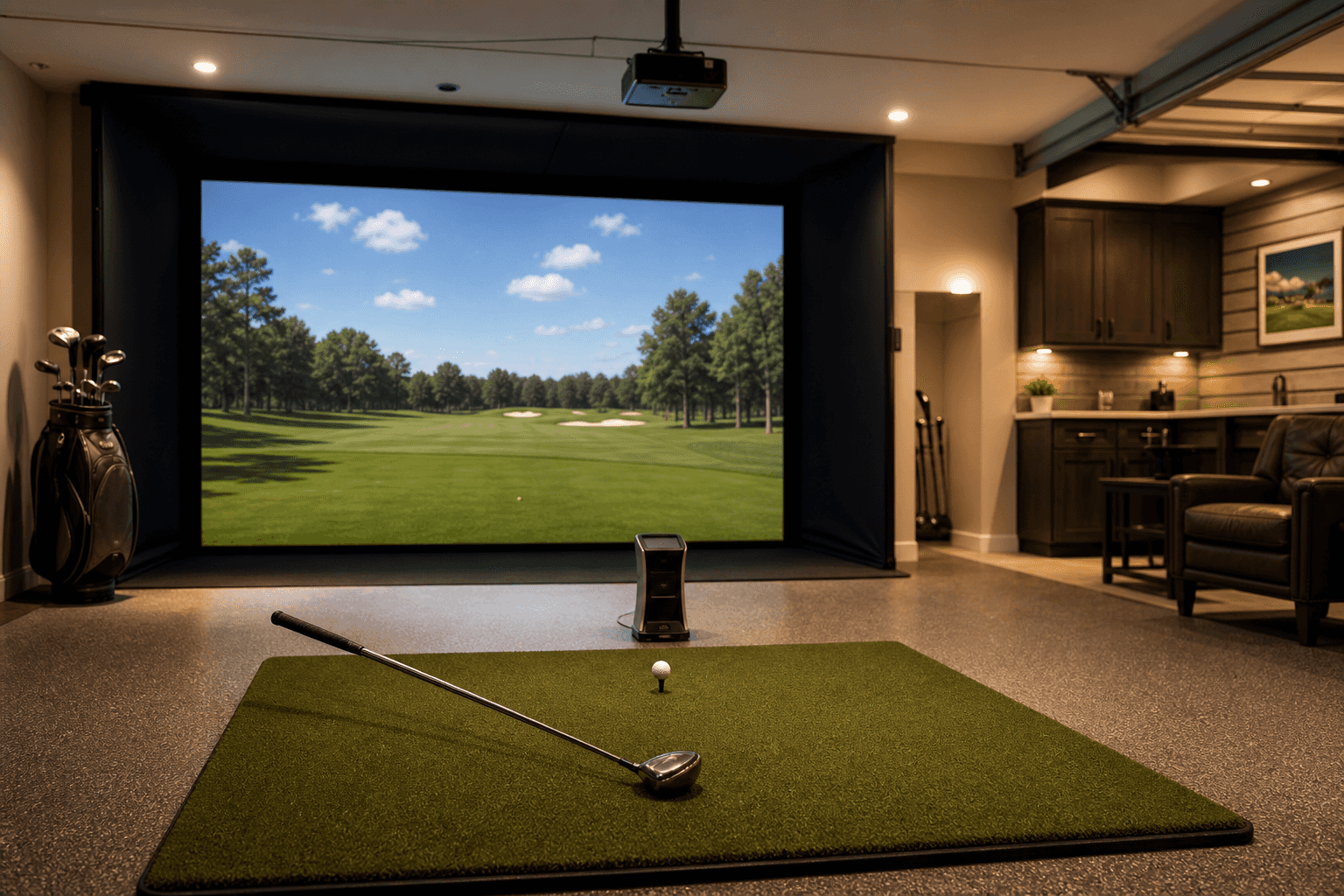
The spec sheets bury the most expensive requirement: space. Plan on a 9-foot ceiling minimum, with 10 to 11 feet preferred for tall golfers and drivers, plus 12 to 15 feet of width and 15 to 18 feet of depth. A garage adds its own line items in lighting, insulation, and the heater that makes January sessions survivable. Concrete under a thin mat also adds a line item to your orthopedist's revenue, which is why the joint-friendly Fiberbuilt mats, rated for more than 300,000 swings, cost $949 and the forum veterans call them the best money in the build.
Measure before you shop. If your ceiling is 8 feet, the answer to this article's question is $45 an hour, and no package price changes that.
Buy the starter if you want winter reps and honest expectations. Build the $5,000 version if you play weekly and have the room; pair it with clubs actually worth swinging and it beats the lounge by year three. And skip the $18,000 package unless someone else is paying, because the extra $13,000 buys the same golf with nicer trim, and the ball still won't go where you aimed it.