Key Takeaway
- A dedicated backyard pickleball court runs about $30,000, and roughly two-thirds of that is the engineered concrete pad, not the paint or the net.
- On a flat slab you already own, a USA Pickleball-endorsed net and regulation lines turn it into a court for $230 to $525.
- The standard build footprint is 30 by 60 feet (1,800 sq ft), oriented north-south, on a 4-inch, 3,000 PSI slab with a 1 percent drainage slope. Skimping on the base is the one unfixable mistake.
- Fencing, lighting, and noise mitigation are what push a court from $30,000 toward $60,000 and beyond. Price sound fencing before you pour if neighbors are close.
- A court is a luxury, not an investment, because public courts are free. Tape your own slab and play a season before committing to concrete.
The top-ranking cost guide prices installation by the square foot at a rate that makes a standard court a $36 million project. Nobody proofread it. Here is math that checks.
Nobody pouring concrete will answer how much a backyard pickleball court costs with a small number, and the search results scatter from $10,000 to $150,000 because everyone is pricing a different product. The honest ladder has three rungs. A flat slab you already own becomes a court for $230 to $525. A real dedicated build runs about $30,000, and roughly two-thirds of that is the concrete pad under your feet. Fencing, lights, and your neighbors' patience decide whether it climbs past $50,000. There is also a fourth number worth remembering before any of this: $0, which is what the public courts your taxes already built charge per hour.
The top-ranking answer prices a $36 million court
Angi's cost guide, the first organic result for this question, states that professional installation "costs $20,000 to $50,000 per square foot." A standard 1,800-square-foot court at that rate is a $36 million project. The page discloses it was created with automation technology and then fact-checked, which raises questions about the checking. The arithmetic problems continue further down: the same page claims most courts cost $4 to $12 per square foot while reporting a $34,000 average for an 880-square-foot court, and $34,000 divided by 880 is $39 per square foot, triple the top of their own range.
The rest of page one is court builders and surfacing vendors, and their spreads tell you what they sell. A tile vendor prices by the kit. A Dallas contractor quotes $25,000 to $100,000. A facility calculator says $20,000 to $150,000. None of them are lying; they are pricing different products and hoping you don't notice which one you need.
The pad is two-thirds of a real build
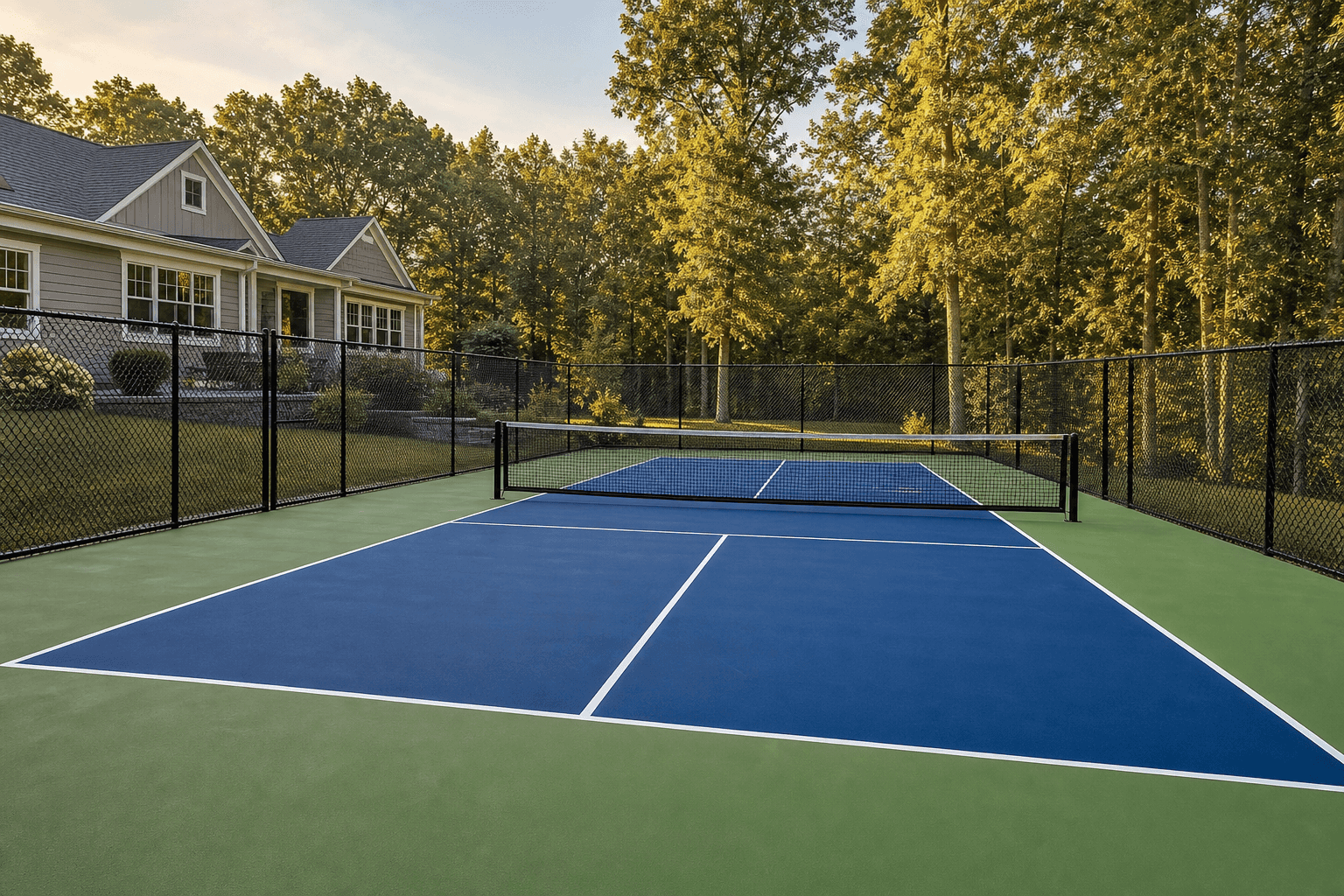
A backyard court's playing lines measure 20 by 44 feet, but nobody sane builds to the lines. The standard footprint is 30 by 60 feet, which adds 8 feet behind each baseline and 5 feet per side so players can chase lobs without leaving the property. That is 1,800 square feet of engineered concrete, and it is the whole ballgame. A pro builder's own cost guide budgets about $30,000 for the foundation on a $30,000-to-$60,000 project and calls it roughly two-thirds of the total, with surfacing, paint, and net installation adding $10,000 to $15,000 more. The per-square-foot math triangulates the same answer from the other direction: cost guides put a finished concrete-and-acrylic court at $11 to $28 per square foot, and 1,800 square feet at those rates spans $19,800 to $50,400, which is exactly the $25,000-to-$50,000 window the credible sources quote.
The raw slab is cheaper than the foundation number suggests: concrete runs $5 to $10 per square foot, so the 30-by-60 pad itself costs $9,000 to $18,000. What inflates it to $30,000 is everything under and around it. Site prep runs $2,000 to $10,000 and up, the pad needs a 1 percent slope so rain drains instead of ponding, the vendor spec sheets call for a 4-inch slab of 3,000 PSI concrete with rebar, which is builder-speak for a real structure rather than a patio, and permits add $200 to $2,000. Contractors favor post-tensioned concrete for sports courts because the thinner slab resists cracking and cures faster, and asphalt is the budget alternative at $5 to $12 and up per square foot. Orient the whole thing north-south while you're at it, so nobody serves into the sun. Skimping on the base is the one unfixable mistake. A court on a bad base cracks and puddles no matter how nice the acrylic on top looks, and the fix starts with a jackhammer.
A slab you already own is worth $29,500
Every dollar above assumes you need new concrete. If a flat driveway, sport pad, or barn floor already exists, the price of pickleball collapses. A USA Pickleball-endorsed portable net like the Picklenet Deluxe runs about $450, budget nets start near $200, and regulation lines cost $30 to $75 whether you use tape rolls or a rubber line set that drops in place in five minutes. A regulation net hangs 36 inches at the sidelines and 34 at center, and the good portable ones hold those numbers without sagging. Mark the kitchen too: the non-volley zone extends 7 feet from the net on each side, and it is where half the game happens. Total: $230 to $525. Call it $500 done properly, which is the cheapest route the cost guides themselves acknowledge, tucked well below their package pricing. The middle step between tape and a full build also exists: a colored acrylic coat with painted lines over the slab you own, permanent enough to skip the setup ritual without pouring an ounce of new concrete.
The honest constraints: the slab needs to be dead flat, and full-size play wants that 30-by-60 footprint, so a typical two-car driveway means a shrunken court and a few balls rolling into the street. Wear actual court shoes, not running shoes, because concrete punishes the wrong tread. And if your HOA owns a dead tennis court, the math gets even better: $5,000 to $20,000 converts one tennis court into four pickleball courts, which is why so many tennis courts now wear four extra sets of lines.
Fencing, lights, and the neighbors decide the last $20,000
The gap between a $30,000 court and a $60,000 one is mostly perimeter and photons. Chain-link is the cheapest enclosure that keeps balls out of the flowerbeds, and lighting runs from several thousand dollars into the tens of thousands depending on poles and fixtures, which is how that Dallas contractor's backyard range reaches $80,000. Budget $300 to $1,500 a year for upkeep after the ribbon cutting.
Then there is the line item no contractor puts on the quote: sound. Pickleball's pop has become suburbia's signature noise dispute, and courts built without acoustic planning are the ones that end up with restricted playing hours after the neighbors organize. If houses sit close, price sound fencing before you pour, not after the certified letter arrives.
The reality check no contractor leads with
A backyard court is a luxury purchase, not an investment, because its main competitor is free. Public courts keep multiplying, and $30,000 buys roughly a lifetime of open play plus gas money. The build makes sense for three kinds of people: daily players tired of waiting for a court, hosts who want the neighborhood gathering spot, and anyone stuck in a genuine court desert. Everyone else should start at the bottom of the ladder.
So tape the slab you own, spend $500 on the good net, and play for a season before you commit to concrete. If you still want the real thing next spring, build the full 30-by-60 pad with the drainage done right, because the pad is the purchase. Everything on top of it is paint.