Key Takeaway
- A mid-range gaming PC played three hours a night costs about $6.78 a month at the April 2026 US average of 18.83 cents per kWh. Even a 600-watt high-end tower runs about $10.
- Measure your own draw with a $25 plug-in meter. Wattage tracks frame rate, not graphics prestige: an uncapped menu at 400 fps can pull more power than a demanding AAA game.
- Idling costs more than playing. A rig left awake at 90 watts for the 21 hours a day you are not gaming burns about $10.68 a month. Sleep mode cuts that to roughly 59 cents.
- Your electricity rate moves the bill more than your GPU. The same habit costs $4.45 a month in North Dakota and $16.78 in Hawaii.
- A console draws about half a mid PC, saving roughly $41 a year: one coffee a month, not a real reason to pick a platform.
A mid-range rig gaming three hours a night adds $6.78 to the average American power bill. The solar companies ranking for this question would rather you didn't do the division.
The gaming pc electricity cost per month question gets answered on page one by Quora threads, solar lead-generation blogs, and a forum post from 2022, which explains why the numbers floating around run anywhere from pocket change to car payment. Run the actual math and it lands in latte territory: a mid-range rig gaming three hours a night costs about $6.78 a month at the current national electricity rate, and even a 600-watt monster runs about $10. The expensive part of owning a gaming PC isn't playing it. It's the habit of never turning it off, which quietly costs more than the gaming does.
The watts, measured at the wall
Ignore the power supply sticker; the number that matters is what the wall meter reads. One of the few published wall-meter tests, run on an RTX 4070 Ti Super system, found a steady 96 watts at the Windows desktop and 400 to 550 watts in modern games. HP's own 2026 guidance for its gaming desktops matches: 450 to 550 watts under load for a mid-range GPU build, 500 to 700 for the high-end towers, and 60 to 100 watts idling. Nvidia rates the RTX 4090 alone at 450 watts, which is why those builds ship with kilowatt-class power supplies. Sleep mode drops the whole machine to somewhere between 1 and 15 watts.
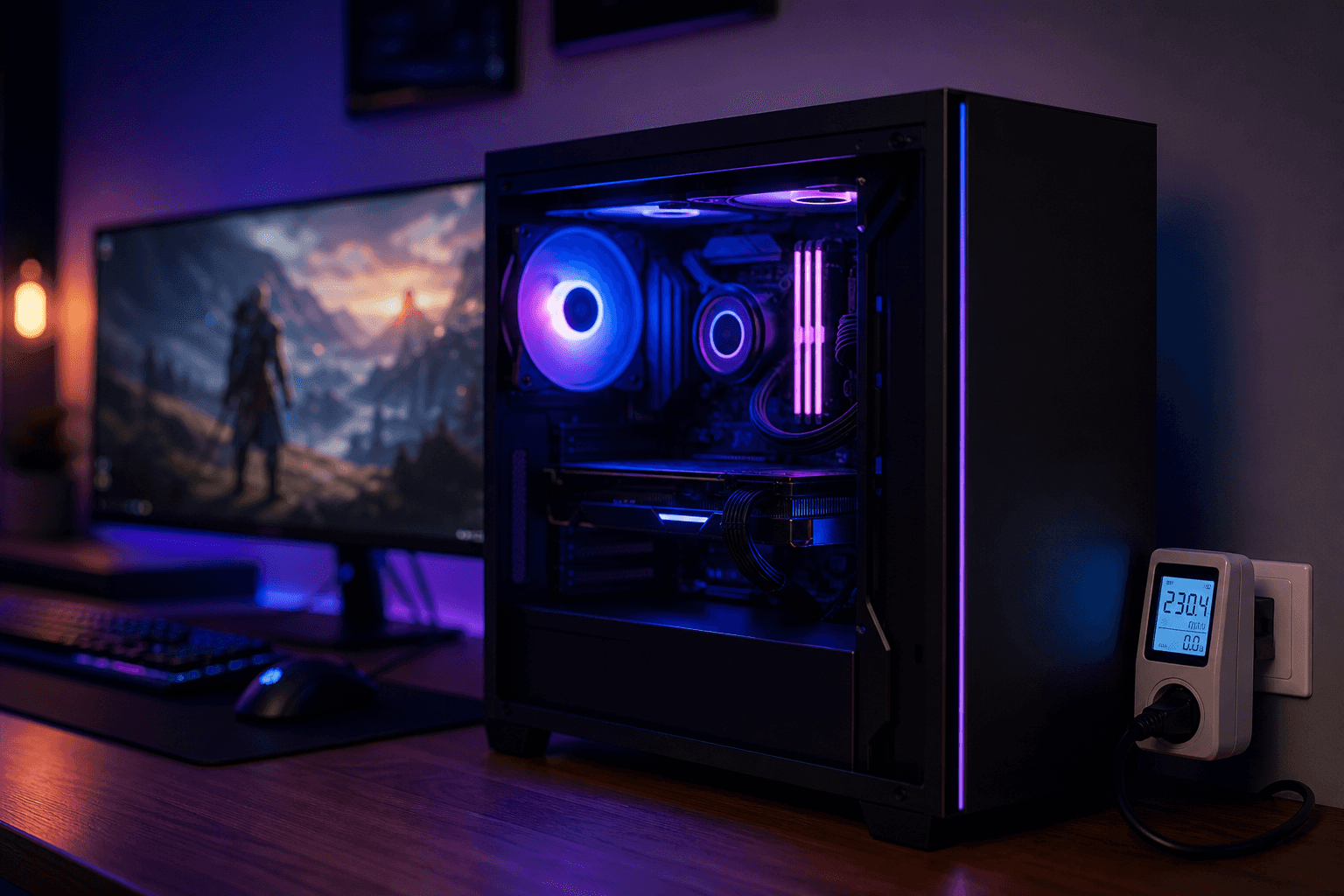
Distrust every published wattage figure, including ours, for the price of a $25 meter. A Kill-A-Watt style meter between the tower and the wall reads your true draw, power-supply losses included, while software like HWiNFO and Afterburner only estimates the components. A smart plug with energy monitoring works nearly as well. Ten minutes of measuring your own machine beats every calculator on page one.
The same wall-meter test surfaced the fun print: wattage tracks the frame rate, not the graphics prestige. A cartoonish fishing game pulled up to 446 watts while the famously demanding Black Myth: Wukong sat around 410, and the champion draw of the whole test was Civilization VI at 562 watts, a game about clicking on hexes. Uncapped menus and loading screens rendering at 400 frames per second burn real money for nothing.
The monthly math at real rates
The national average residential electricity rate sits at 18.83 cents per kilowatt-hour as of April 2026 per the EIA, up 25 percent since 2022, which is exactly why this question is getting Googled more. The climb traces to natural gas prices, grid-hardening spending, and, with some irony, data centers full of the same GPUs. EIA's short-term outlook projects another 3 to 5 percent a year through 2027, so every habit fix below compounds. Here is the honest grid, using measured wattages and 30-day months.
| Daily play | 300W modest rig | 400W mid rig | 600W high-end |
|---|---|---|---|
| 1 hour | $1.70 | $2.26 | $3.39 |
| 3 hours | $5.08 | $6.78 | $10.17 |
| 6 hours | $10.17 | $13.56 | $20.34 |
For scale, the average American home burns 869 kilowatt-hours a month for a bill around $150. The mid-rig gamer's 36 kilowatt-hours is 4 percent of that. Your state moves the decimal more than your graphics card does: the same 400-watt, three-hour habit costs $4.45 a month in North Dakota, $7.02 in Ohio, $12.69 in California, and $16.78 in Hawaii. If a solar installer's blog told you your PC costs $50 a month, they were pricing Honolulu hours on a rig you don't own.
Gaming laptops are the quiet efficiency play in all of this: 80 to 300 watts in games and a few hundred kilowatt-hours a year, less than half a desktop's appetite, because every component was engineered to sip from a battery. The tradeoff is thermals and upgrade paths, never the power bill, which stays in single digits.
Leaving it on costs more than playing on it
Here is the number that should change a habit. That mid-range rig idling at 90 watts for the 21 hours a day you aren't playing burns 56.7 kilowatt-hours a month, which is $10.68 of desktop screensaver against $6.78 of actual gaming. The always-on gamer pays more for nothing than for something. Put the machine to sleep instead and those 21 daily hours cost 59 cents a month, a one-button saving of roughly $121 a year.
The research agrees at population scale. Lawrence Berkeley National Laboratory's gaming-energy work pegs gaming rigs at roughly a fifth of all PC energy use, with the average machine at about 1,400 kilowatt-hours a year, which is $264 at today's rate and roughly triple the pure-gaming math above. The gap between the study average and the spreadsheet is mostly machines sitting powered on around the clock. The cheapest upgrade in PC gaming remains the sleep setting, followed closely by a frame cap: the wall-meter test found that limiting Far Cry 6 to 60 fps cut draw substantially, because pixels you never see still bill you. Undervolting and sane power settings trim another 30 to 40 percent off draw without touching the frames you keep. And the always-on excuses don't survive arithmetic: downloads and updates don't need 90 waking watts, they need a scheduled wake timer.
A console saves you one coffee, not a car payment
The eternal PC-versus-console budget argument evaporates at the outlet. A PS5 or Xbox Series X draws 160 to 200 watts in gameplay, so the same 90 monthly hours cost about $3.39 against the mid PC's $6.78. That is a $3.39 monthly gap, roughly $41 a year, or one takeout coffee a month for triple-digit frame rates and a mod folder. Buy whichever box has your games; electricity is a rounding error in that decision, and anyone using power bills to argue platform wars is losing the argument somewhere else.
Honest caveats run in both directions. Heavy players on flagship hardware in expensive states do reach real money: six daily hours on a 600-watt tower in California is about $38 a month, and that person should cap frames and mind the sleep timer. And none of this includes the monitor or the router, which add a few watts of their own.
Perspective lives one room away. We ran this same math on window air conditioners, and cooling one room in summer beats the gaming PC's bill without breaking a sweat, which is fitting. If the power bill keeps you up at night, start with the appliances worth unplugging, set the PC to sleep after 15 minutes, cap your frames at whatever your monitor can actually show, and go back to playing. Seven dollars a month buys a lot of guilt-free hexes.