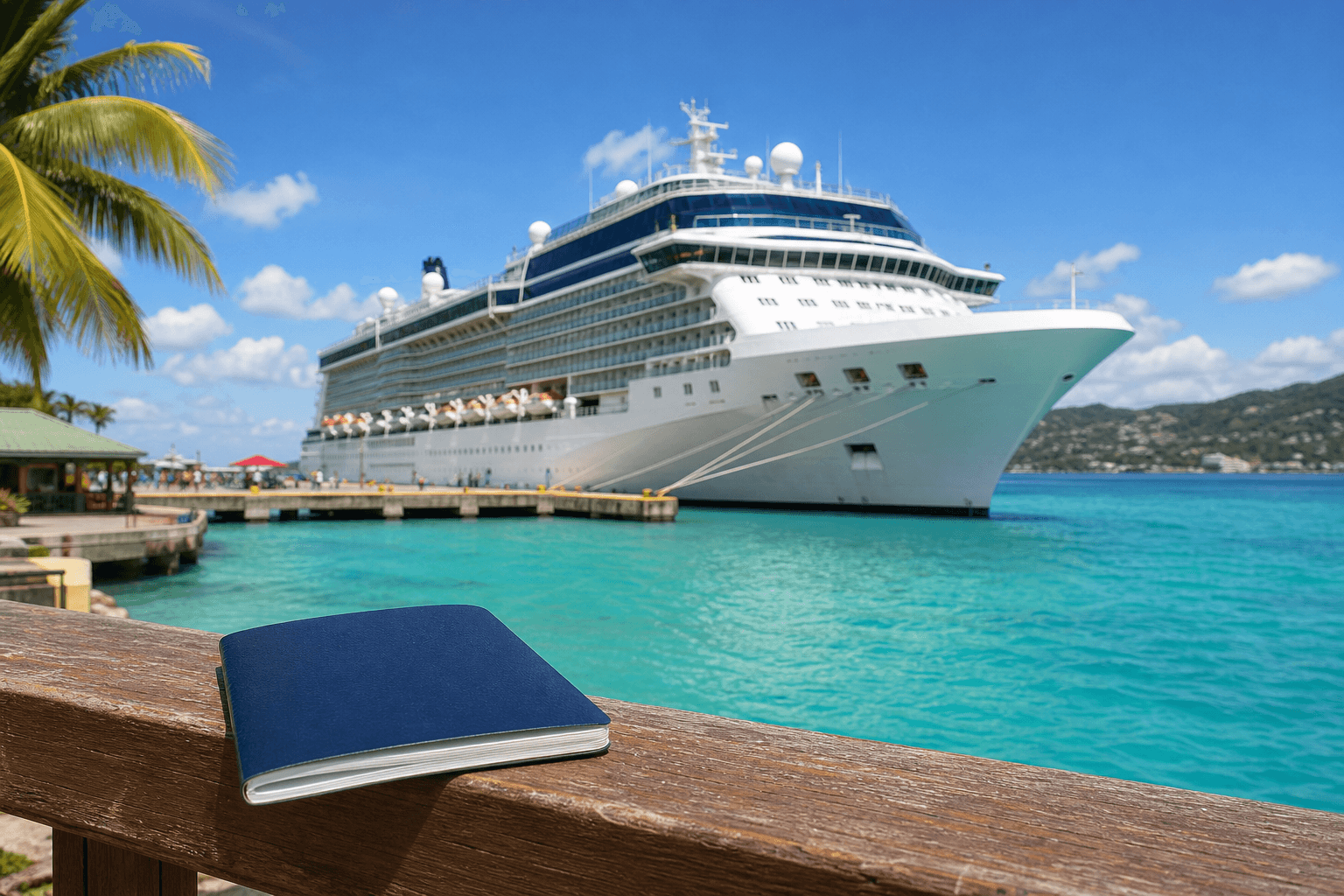
Key Takeaway
- Legally, a US citizen on a closed-loop cruise (one that begins and ends at the same US port) can re-enter the country on a certified birth certificate plus a government-issued photo ID. No passport required.
- You should still bring a passport. It is the only document that guarantees you can fly home from a foreign port in a medical or family emergency, and a birth certificate cannot board an international flight.
- A passport card satisfies the sea crossing but is not valid for international air travel, so the card that got you onto the ship cannot fly you home.
- Some ports of call, including Barbados, Martinique, Guadeloupe, Haiti, St. Barts, and Trinidad and Tobago, can require a passport for shore visits, and then the cruise line requires it at check-in too.
- Common denied-boarding traps: a hospital souvenir birth certificate, a name that does not match your booking, and confusing a Real ID with an enhanced driver's license.
Federal law lets a U.S. citizen sail round-trip from a home port, touch a foreign country, and come back without ever owning a passport. That is real, it is on the books, and the cruise lines advertise it. The question people actually search, do you need a passport for a closed loop cruise, has a two-part answer that no booking page wants to give you in one breath: legally no, and you should still pack one anyway.
A closed-loop cruise is the cleanest definition in travel. It begins and ends at the same U.S. port. Fort Lauderdale to the Caribbean and back to Fort Lauderdale. Seattle to Alaska, with a stop in Canada, and back to Seattle. Because the trip starts and finishes on American soil, U.S. Customs and Border Protection lets citizens re-enter on lighter paperwork than air travel demands.
The legal answer: a birth certificate and a photo ID are enough
Under the Western Hemisphere Travel Initiative, the rule CBP put in place in 2009, U.S. citizens on a closed-loop sailing can re-enter the country on a certified birth certificate paired with a government-issued photo ID. No passport line item. A driver's license and a birth certificate together clear you back in.
Children are easier still. Kids under 16 need only proof of citizenship, usually a birth certificate, with no photo ID required because they rarely have one.
A few alternatives satisfy the same rule. An enhanced driver's license works as a single document, but only a handful of states issue them: Michigan, Minnesota, New York, Vermont, and Washington, as of 2026. A passport card also qualifies for the sea crossing. Hold that passport card detail, because it sets a trap discussed below.
Lawful permanent residents and non-citizens do not get the birth-certificate shortcut. A green-card holder still presents the I-551 card, and a traveler who is neither a U.S. citizen nor a permanent resident needs a passport regardless of how the cruise loops.
Why a passport still belongs in your bag
Here is the part the "no passport needed" headlines skip. The birth-certificate route works beautifully right up until something goes wrong in a foreign port, and then it collapses.
Picture a medical issue in Cozumel, a family emergency back home, or a flight delay that makes you miss embarkation and forces you to meet the ship at its next stop. In every one of those cases you are no longer crossing back by sea on a cruise deck. You are buying a plane ticket. International air travel into the United States requires a passport, full stop, and a birth certificate will not board a plane. AAA puts the stakes plainly, calling a passport the ONLY document that guarantees you can fly home from a foreign port in an emergency.
Two common reassurances do not rescue you here. The first is the passport card. It satisfies the closed-loop cruise because that is a sea crossing, but passport cards are not valid for international air travel, so the card that got you onto the ship cannot fly you home. The second is CBP's emergency discretion. The agency can wave a documentless citizen back into the country in genuine emergencies, but that discretion applies to re-entry by sea, not to an airline counter in another country deciding whether to let you board. The passport solves the flight. The workarounds do not.
Some ports want a passport even on a closed-loop sailing
The closed-loop exception is a U.S. re-entry rule. It says nothing about what the countries on your itinerary demand when you step off the ship for the afternoon. CBP states it directly: you may still need a passport to enter the places your ship visits, and the cruise line is the one that confirms what each stop requires.
In practice this bites in the Caribbean. Several destinations, including Barbados, Martinique, Guadeloupe, Haiti, St. Barts, and Trinidad and Tobago, can require a passport for shore visits, and one cruise line lists Panama, Colombia, Martinique, and Bermuda as itineraries that demand a passport before you even board. If a port on your route requires one, the cruise line will require it at check-in too, which turns the "optional" passport into a boarding condition.
How you book shore time changes the risk
This is the connection the single vendor pages rarely make, because each one is selling its own excursions. The missed-ship nightmare, the scenario where the birth-certificate route leaves you stranded, is partly within your control, and the lever is how you book your day on land.
Book an independent tour or wander off on your own, and the ship leaves on schedule whether you are aboard or not. Miss it, and catching up means an international flight and the passport you may not have. Book the cruise line's own shore excursion, and the math changes. As Celebrity describes its guarantee, if a sanctioned tour runs late, the ship is guaranteed to wait for you. That does not eliminate the case for a passport, since medical emergencies ignore your excursion choice, but it shrinks the most common way travelers get into trouble without one.
The paperwork traps that deny boarding
If you do sail on a birth certificate, the document has to be the right kind. CBP technically accepts a photocopy, but cruise lines routinely demand stricter proof and can turn you away at the pier, so the line's policy is the one that governs your trip.
Three traps account for most denied boardings. The first is the wrong birth certificate: a hospital souvenir certificate or baptismal record will not work, only one issued by a state, county, or vital-records office. Puerto Rican certificates issued before July 2010 are also rejected. The second is a name mismatch. If the name on your birth certificate does not match the name on your booking, usually after a marriage, you need the marriage certificate or court order to bridge the gap, or boarding can be refused. The third is forgetting that a Real ID driver's license is not an enhanced one. Real ID gets you through airport security; it does not prove citizenship for a cruise.
So who can safely skip the passport
The honest decision comes down to your itinerary and your tolerance for the tail risk. A first-time cruiser on a simple round-trip to the Bahamas or a Western Caribbean loop, booking the ship's own excursions, with a clean name match and a certified birth certificate, can reasonably sail without a passport and save the fee. That is exactly the traveler the closed-loop rule was written for.
Everyone else leans the other way. If your itinerary touches a port that wants a passport, if you are managing a chronic health condition, if you booked independent shore plans, or if you simply do not want a stranded-abroad story, the passport is cheap insurance against an expensive afternoon. It also future-proofs you, since the same book covers the next trip that does require it. If your next trip is by air rather than sea, the validity math changes, and our guide to whether you need 6 months on your passport covers it.
If you decide to get one, build in time, because processing runs weeks even in routine periods. Our guide to passport renewal covers the current timelines, and since the worst-case scenarios here are medical and logistical, it is worth reading our travel insurance breakdown before you sail. Already committed to the ship? The math on the Royal Caribbean drink package is a better use of your prep time than worrying about a document you now understand.
Frequently asked questions about closed-loop cruise documents
Do you need a passport for a closed-loop cruise?
Legally, no. A US citizen on a closed-loop cruise (one that starts and ends at the same US port) can re-enter the country on a certified birth certificate plus a government-issued photo ID under the Western Hemisphere Travel Initiative. You should still bring a passport, because it is the only document that lets you fly home if a medical issue, family emergency, or missed embarkation strands you in a foreign port.
What documents do you need for a closed-loop cruise without a passport?
A certified birth certificate (issued by a state, county, or vital-records office, not a hospital souvenir) paired with a government-issued photo ID. Children under 16 need only proof of citizenship. An enhanced driver's license or a passport card also works as a single document for the sea crossing. The cruise line's document policy is stricter than CBP's, so follow it.
Can you use a passport card for a cruise?
Yes for the closed-loop cruise itself, because that is a sea crossing. But a passport card is not valid for international air travel, so if you have to fly home from a foreign port in an emergency, the card cannot board the plane. That gap is exactly why a full passport book is the safer choice.
What happens if you miss the ship without a passport?
You have to catch up to the ship at its next port or fly home, and both involve international air travel that requires a passport a birth certificate cannot satisfy. Booking the cruise line's own shore excursions reduces the risk, because a sanctioned tour that runs late means the ship is guaranteed to wait for you.